Every state licenses its own teachers, and each one lists its own routes: a traditional route through a state-approved preparation program, an alternative or intern route for people who already hold a bachelor’s degree, sometimes an apprenticeship, a route for teachers licensed in another state, emergency or provisional permits that a district asks for, and substitute permits. The route finder above covers 14 states whose rules we read in official text. For each route it shows the minimum the state lists (a degree, a finished program, a license, years taught, a district’s request), then sets your entries against it: “stated minimum met by your entry” or “not met by your entry”. It also names the tests the state lists for your level, with fees, and the agency’s page.
This page is general information, not legal or career advice. Each state’s licensing agency decides every application, and rules, tests and fees change, often on 1 July. Confirm the current rules with the agency before you pay for a program, a test or fingerprints.
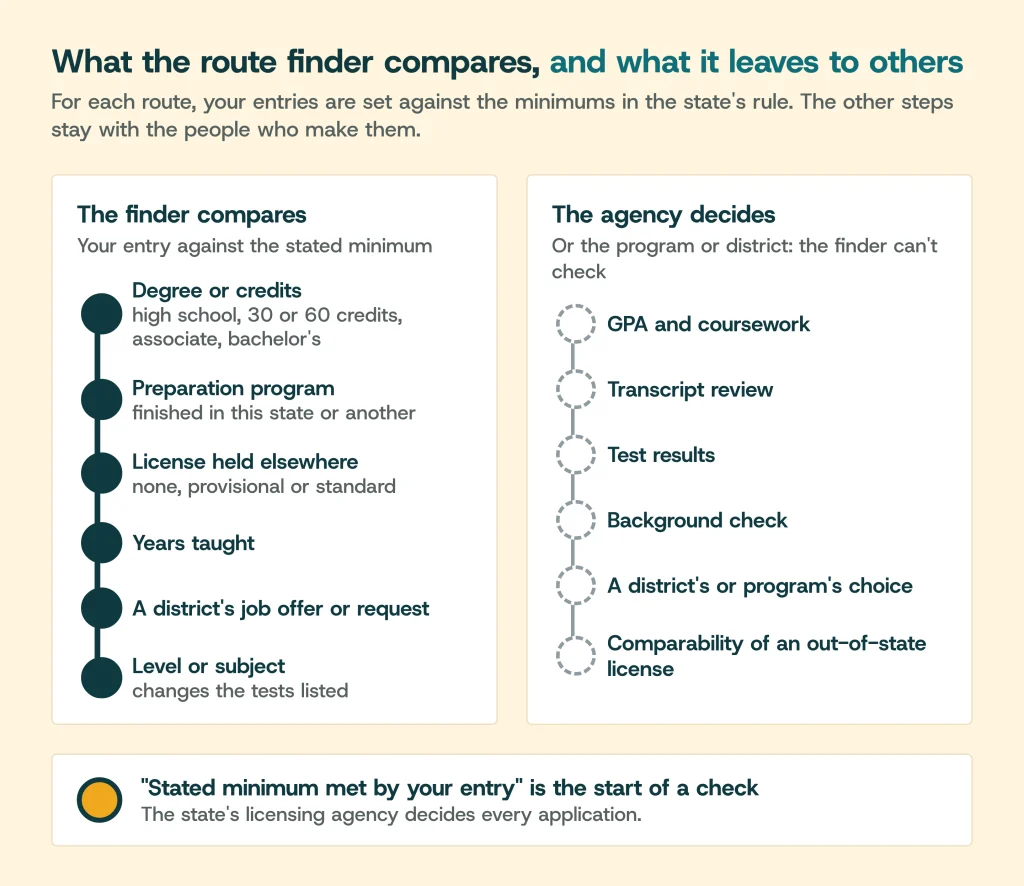
The finder never says whether you are eligible, and it never picks a route for you. It compares only what a tool can compare. Your GPA, a transcript review, a background check and a district’s hiring decision stay with the people who make them. For the wider picture of how routes work, start with Becoming a Teacher. Rules on this page were read from 11 to 13 November 2026, with the source and date named at each rule.
What the finder asks and shows
It asks seven questions. Each one is a choice, so there is nothing to type except years taught.
- State. California, Colorado, Florida, Georgia, Illinois, Michigan, New Jersey, New York, North Carolina, Ohio, Oklahoma, Pennsylvania, Texas or Washington. For any other state or DC, the finder says “not in the finder yet” and points to the 51-state certification table, which shows what we have read for every state.
- Highest education completed: high school diploma or GED; 30 to 59 college credits; 60 or more credits without a degree; an associate degree; a bachelor’s; a master’s or higher. States set floors at each of these points, mostly for substitutes.
- A state-approved teacher preparation program (an educator preparation program, or EPP, that the state has approved): finished one in this state, finished one in another state, or none finished.
- Level or subject: early childhood, elementary, a secondary subject, special education, or career and technical education. This changes the tests it lists.
- A license held in another state: none; a provisional, intern, emergency or temporary one; or a standard or professional one. States treat these two kinds very differently.
- Years taught full time under that license.
- A job offer or request from a school or district in this state. Several routes exist only when a district asks for you.
For each of the six route types, it shows two lines. The first is what the state lists, with its rule. The second sets your entries against that rule, in one of four ways:
- Stated minimum met by your entry. What you entered matches each minimum the finder can compare. The agency still decides, and the route has further steps.
- Stated minimum not met by your entry. At least one listed minimum (a degree, a finished program, a license, years, a district’s request) doesn’t match what you entered.
- No state minimum to compare: the district or agency decides. The state leaves this route to districts, or it turns on a district’s or agency’s choice.
- Not confirmed for this state: ask the agency. We did not read a stated minimum for this route in official text, so the finder says nothing about it.
Below the routes come the tests the state names for your level, with fees as read; the agency, its headline fees and the read date; and a reminder of what the finder can’t check. Praxis fees come from ETS’s Praxis Information Bulletin 2026-27, for tests taken from 1 August 2026 to 31 July 2027, and online purchases add a 3% non-refundable service fee (read 13 Nov 2026). State fees often change on 1 July. To add the fees up, use the teacher certification cost calculator.
The six route types in plain words
States use different names for the same ideas. In this finder, a certificate, license or credential all mean the state’s permission to teach; each state uses its own word.
- Traditional. You finish a state-approved preparation program, usually inside or after a bachelor’s degree, pass the tests the state names, and the program recommends you. The first license is often called initial, preliminary, residency or Instructional I.
- Alternative or intern. You already hold a bachelor’s degree, often in another field. You teach on a temporary license while you finish an approved program. Some states require a teaching job first. To check a program, see how to check that a program is state-approved; how each state runs its alternative route is in alternative teacher certification by state.
- Apprenticeship. A paid, on-the-job route, often from a paraprofessional (teacher’s aide) post. Of the 14 states here, the only apprenticeship route we read in official text is Florida’s; for the others the finder says “not confirmed”.
- Out-of-state license. You hold a license elsewhere. The receiving state decides what equivalent license, if any, it issues, and what tests or coursework it still wants. The reciprocity and compact checker goes deeper.
- Emergency or provisional. A short permit, usually asked for by a district that can’t fill a post. These are not a shortcut to a full license; see emergency and provisional certificates by state.
- Substitute. Floors run from a high school diploma to a bachelor’s degree, with day limits. More in how to become a substitute teacher.
Routes in the 14 states
A short version first. Each state’s fold-out below gives the rule behind every line of the finder, with its source and the date read. The tests are in short here; the full list by state is on certification tests by state.
| State | Alternative route | Moving with a license | Substitute floor |
|---|---|---|---|
| California | Intern credential | Comparable credential | Bachelor’s |
| Colorado | Alternative license, with a job | $110 review; compact bridge | High school diploma |
| Florida | Temporary Certificate | Standard certificate | High school diploma |
| Georgia | GaTAPP, with a job | Professional certificate | Diploma or GED + 4 hours |
| Illinois | ELS alternative provisional | License or program | Bachelor’s; short-term 60 credits |
| Michigan | Interim certificate, with a job | MTTC waived with 3 years | 60 credits or associate |
| New Jersey | Certificate of Eligibility | Standard, or CEAS | 30 credits |
| New York | Transitional B, with a job | No NY exams with 3 years | No state certificate |
| North Carolina | Residency License, school request | Programs recognised | District-set |
| Ohio | Alternative Resident Educator | 1-year license, district request | Degree; no-degree temporary |
| Oklahoma | Alternative Placement (secondary) | Standard license, no extra tests | Not confirmed |
| Pennsylvania | Not confirmed | Three pathways, one by compact | Bachelor’s |
| Texas | Alternative EPP | $164 review; temporary certificate | District-set |
| Washington | PESB routes (not confirmed) | 3 years or a program | Program or 3 years; emergency |
California: read 12-13 Nov 2026
- Agency: Commission on Teacher Credentialing (CTC). Lookup: CTC credential lookup. Approved programs: CTC dashboard
- Traditional: a Commission-approved program, a teaching performance assessment and the program’s recommendation give a Preliminary credential (CTC leaflets CL-561 and CL-561C, read 12 Nov 2026). A bachelor’s degree meets the basic skills requirement (Ed. Code 44252(b)(12), as amended by SB 153 of 2024)
- Alternative or intern: University Intern credential (CTC also lists District Intern credentials): a bachelor’s degree, subject matter shown by exam, program or degree major, and a U.S. Constitution course or exam; valid two years, and employment is restricted to a specific school agency (CL-402A, updated 1 Oct 2026, read 13 Nov 2026)
- Moving with a license: a bachelor’s and a comparable professional-level credential from another state gives a Preliminary; two or more years with an employer’s letter and two satisfactory evaluations can give a Clear; National Board certification gives a Clear (CL-561, read 12 Nov 2026)
- Emergency or provisional, apprenticeship: not confirmed in what we read
- Substitute: Emergency 30-Day Substitute Teaching Permit: a bachelor’s (which also meets basic skills), fingerprints, $100; 30 days per teacher a year, 20 in special education (CL-505p, updated 23 Oct 2026, read 13 Nov 2026)
- Fees: $100 per credential plus a $2.65 online fee (CL-659, read 12 Nov 2026). Live Scan: the Department of Justice lists $32 and the FBI $17 on a schedule dated 2012, plus the site’s own fee
Colorado: read 12 Nov 2026
- Agency: Colorado Department of Education (CDE). Lookup: CDE credential search. Approved programs: CDE program search
- Traditional: Initial Teacher License, 3 years, $90, after an approved program and a content exam for each endorsement (CDE, read 12 Nov 2026)
- Alternative: Alternative Teacher License: a bachelor’s, content shown by exam or degree, a teaching job in the area and an agreement with a Colorado designated agency; $90 (CDE, read 12 Nov 2026)
- Moving with a license: $110; a 1-, 3- or 7-year license by qualifications. Under SB26-126 (effective 12 Aug 2026), CDE is to issue an initial license within 30 days to a holder of an unencumbered equivalent license from a compact member state who passes the background check, with no added coursework or exams for it, until CDE issues licenses under the compact (read 12 Nov 2026)
- Emergency or provisional: Interim Authorization, 1 year, renewable once; stated minimums not confirmed (CDE, read 12 Nov 2026)
- Substitute: 1-year authorization: high school diploma and experience with children, $60; 3-year: a bachelor’s, $90; 5-year: license holders, $90 (CDE, read 12 Nov 2026)
- Background check: $39.50 to CBI (CBI, read 13 Nov 2026) plus the fingerprint vendor’s fee (not read)
Florida: read 12-13 Nov 2026
- Agency: Florida Department of Education (FLDOE). Approved programs: FLDOE list
- Basic requirements: at least 18, a bachelor’s or higher and a 2.5 GPA in the major, background screening, general knowledge and subject mastery (s. 1012.56(2), read 13 Nov 2026)
- Traditional and alternative: the Professional Certificate (5 years) after an approved program, an Educator Preparation Institute or a district Professional Learning Certification Program. The Temporary Certificate (5 school fiscal years, once, not renewable) needs the basics and subject content; it is also open to 48 months’ active duty with 60 credits and a 2.5 GPA, and to people enrolled in an approved program who are doing their field experience in a public school with 60 credits and a 2.5 GPA (s. 1012.56(7), read 13 Nov 2026)
- Apprenticeship: Teacher Apprenticeship Program: an associate degree with a 2.5 GPA, background screening, a temporary apprenticeship certificate, appointment by the district as a paraprofessional, and at least two years with a mentor teacher (s. 1012.555, read 13 Nov 2026)
- Moving with a license: a valid standard certificate from another state, comparable to the Professional Certificate, meets general knowledge and professional preparation (s. 1012.56(3), (6), read 12 Nov 2026)
- Substitute: districts set the rules; the statute requires at least a high school diploma or equivalent, fingerprints and orientation training (s. 1012.35, read 13 Nov 2026)
- Fees: $75 per subject (Rule 6A-4.0012, effective 25 Aug 2026). Fingerprint fees are set by the district or vendor: not confirmed
Georgia: read 11-13 Nov 2026
- Agency: Georgia Professional Standards Commission (GaPSC). Lookup: GaPSC certification lookup
- Traditional: an approved program gives an Induction certificate, then a Professional certificate, 5 years (GaPSC Rules 505-2-.04 and -.05, read 11 Nov 2026)
- Alternative: GaTAPP, which GaPSC calls the state’s only alternative route to initial teacher certification, for people with a bachelor’s or higher who have not finished a preparation program (GaPSC non-traditional preparation page, read 13 Nov 2026). Candidates hold a Provisional certificate and are employed as a teacher by a Georgia school system, private school or approved charter school while they complete it; content knowledge is shown by a major or the GACE content assessment, and the GACE Ethics assessment is passed before acceptance (GaTAPP admission requirements, read 13 Nov 2026)
- Moving with a license: a professional certificate in a comparable field from a state-approved bachelor’s-level program gives an Induction or Professional certificate; you still pass or are exempted from GACE content, pass GACE Ethics and meet the literacy requirement (GaPSC, read 11 Nov 2026)
- Substitute: no state certificate. Rule 505-2-.20 sets a floor of a high school diploma or GED and 4 hours of district training; a substitute with only a diploma may teach at most 10 days in a row in one classroom (read 12 Nov 2026)
- Fees: at most $20 per application, none for a first certificate from a Georgia program; fingerprints $51.99 through the state’s fingerprint service (read 11 Nov 2026)
Illinois: read 12-13 Nov 2026
- Agency: Illinois State Board of Education (ISBE). Approved programs: ISBE program list
- Traditional: Professional Educator License after an Illinois-approved program and the ILTS content test; $100, or $150 if not entitled by an Illinois program (105 ILCS 5/21B-40, read 12 Nov 2026)
- Alternative: alternative provisional educator endorsement on an Educator License with Stipulations: a bachelor’s, the first phase of an alternative licensure program and a passed content test; valid 2 years, renewable for a third (105 ILCS 5/21B-20(2)(B), read 13 Nov 2026)
- Moving with a license: a comparable out-of-state license and a bachelor’s, or a completed state-approved program; the Illinois content test unless one was passed for the first license; a new provisional educator endorsement lets out-of-state applicants teach for 2 fiscal years while they pass content tests (21B-35; P.A. 104-803, read 12 Nov 2026)
- Substitute: Substitute Teaching License: a bachelor’s, or enrolment in an Illinois program with 90 credit hours; 5 years; $50. Short-Term Substitute: an associate degree or 60 credit hours and a required training program; at most 15 days in a row per teacher, and a district may not use one for a teacher absence of 6 or more days unless a public health disaster has been declared; applications are open until 30 Jun 2028; $25 (21B-20(3)-(4), read 13 Nov 2026; fees 21B-40)
- Background check: requested by the district; applicants other than substitutes may not be charged (105 ILCS 5/10-21.9, read 12 Nov 2026)
Michigan: read 11-13 Nov 2026
- Agency: Michigan Department of Education (MDE). Lookup: MOECS public search. Approved programs: MOECS program list
- Traditional: Standard Teaching Certificate, 5 years, $160, after an approved program and the MTTC (MDE, read 11 Nov 2026)
- Alternative: under MCL 380.1531i, a bachelor’s and enrolment in an approved alternative route program, whose cohort must average a 3.0 GPA; the Interim Teaching Certificate (5 years, issued once) follows a passed MTTC, and MDE says employment as a teacher in the area is a prerequisite. Early childhood, career and technical education, and the special education endorsements in autism spectrum disorder, visual impairments and deaf and hard of hearing are not available this way (MDE alternative routes page, read 13 Nov 2026); Interim certificate $160 (MDE, read 11 Nov 2026)
- Moving with a license: the MTTC is required unless you have 3 years’ successful teaching under the out-of-state certificate; $210 (MDE, read 11 Nov 2026)
- Substitute: Daily Substitute Permit, issued to the school: 60 semester hours or an associate degree; at most 90 calendar days in one assignment; a bachelor’s for special education; $45 (MDE permits page, read 12 Nov 2026)
- Fingerprints: requested by the employer and collected by the Livescan vendor; the amount is not confirmed
New Jersey: read 12-13 Nov 2026
- Agency: NJDOE Office of Certification and Induction. Lookup: Educator License Search in NJEdCert. Programs: CEAS providers, CE providers
- Traditional: an approved program gives a Certificate of Eligibility with Advanced Standing (CEAS), $170 (N.J.A.C. 6A:9B-5.6, read 12 Nov 2026)
- Alternative: Certificate of Eligibility (CE): a bachelor’s or higher; a 3.00 GPA for graduates from 1 Sep 2016 (2.75 before that); a 2.75-2.99 GPA can be offset by a subject test score 10% above passing, or by a CE program’s sponsorship while employed; the State subject test (6A:9B-8.3, read 13 Nov 2026)
- Moving with a license: a valid standard out-of-state certificate plus two effective years of teaching within three consecutive years gives a standard certificate; without them, a CEAS. An out-of-state CE holder has no reciprocity and meets 8.3 instead, except through the Alternate Route Interstate Reciprocity Pilot Program at a participating CE program (6A:9B-8.8, read 13 Nov 2026)
- Emergency: $95 (6A:9B-5.6); stated minimums not confirmed here
- Substitute: 30 semester-hour credits, $125, 5 years; at most 20 days in the same classroom a school year unless extended (6A:9B-7.2 and 7.3, read 13 Nov 2026)
- Background check: $10 plus $1 online, then $68.98 to IDEMIA (NJDOE’s figure, effective 1 Jul 2023)
New York: read 12 Nov 2026
- Agency: NYSED Office of Teaching Initiatives. Lookup: certificate holder search. Programs: Inventory of Registered Programs
- Traditional: a New York registered program and its recommendation give the Initial certificate; Educating All Students and the Content Specialty Test; $50 per title (NYSED, read 12 Nov 2026)
- Alternative: Transitional B: a bachelor’s with a 3.0 GPA, a subject major or 18 semester hours in it plus 12 related, the required exams, and an employment and mentoring commitment while enrolled in an alternative program; up to 3 years; $50 (NYSED, read 12 Nov 2026)
- Moving with a license: endorsement of a comparable certificate with 3 years of certified public-school teaching rated effective needs no New York exams; a program completed in another state needs all New York exams and workshops (NYSED, read 12 Nov 2026)
- Substitute: no state substitute certificate; an uncertified substitute not working toward certification may work 40 days a year in a district, more in the cases NYSED lists (NYSED substitute page, read 12 Nov 2026)
- Fingerprints: $107.50 since 1 Oct 2026
North Carolina: read 11-13 Nov 2026
- Agency: NC Department of Public Instruction (DPI). Lookup: DPI licensure system. Programs: DPI list
- Traditional: Initial Professional License, 3 years, not renewable, after a recognized program; $70 (G.S. 115C-270.20(a)(3), read 13 Nov 2026; fee 16 NCAC 06C .0371)
- Alternative: Residency License, 1 year, renewable twice: a bachelor’s or advanced degree, relevant coursework or a passed content exam, enrolment in a recognized program, and a request from a public school unit (or an approved nonpublic special education school) with the program’s certification of supervision (115C-270.20(a)(5), read 13 Nov 2026)
- Emergency: Emergency License, 1 year, not renewable: a bachelor’s with relevant coursework, requested only by the local board (115C-270.20(a)(2), read 13 Nov 2026)
- Moving with a license: approved programs from every state are recognised and comparable exams accepted; out-of-state IPL $100 (DPI FAQ, read 11 Nov 2026). A Limited License (3 years, one district) exists for teachers licensed elsewhere for 3 years whom a local board seeks to employ (115C-270.20(a)(4a))
- Substitute: no state license; each district sets requirements (DPI FAQ, read 11 Nov 2026)
- Fingerprints: local boards may not charge applicants (G.S. 115C-332)
Ohio: read 12-13 Nov 2026
- Agency: State Board of Education. Lookup: CORE public lookup
- Traditional: Resident Educator License, 2 years, $80, after an approved program and the OAE tests (OAC 3302-24; SBOE fee page, read 12 Nov 2026)
- Alternative: Alternative Resident Educator License: a bachelor’s; the pedagogical training institute or an approved program’s preservice training (which may require a 2.5 undergraduate or 3.0 graduate GPA); a passed subject exam; valid 2 years, renewable; $80 (ORC 3319.26, read 13 Nov 2026)
- Moving with a license: a one-year, non-renewable Out-of-State Educator License, $40, at the request of an employing Ohio district, for a holder of a valid out-of-state standard license with a bachelor’s, an approved program and that state’s exam, while passing Ohio’s exam; for early childhood, primary, middle childhood and intervention specialist licenses, at least 6 of the 12 semester hours of reading coursework are also needed, with the rest finished before the license expires (OAC 3302-24-05(I), read 13 Nov 2026)
- Substitute: the law requires a post-secondary degree in any subject (ORC 3319.226), while the State Board’s checklist asks for a bachelor’s; a school may hire someone with no degree who meets its own requirements, and the law has the State Board issue that person a one-year temporary substitute license (ORC 3319.102), both read 13 Nov 2026. Fees $25 (1 year) or $125 (5 years)
- Background checks: $22 state and $27 FBI, plus any WebCheck location fee
Oklahoma: read 12-13 Nov 2026
- Agency: Oklahoma State Department of Education (OSDE). Lookup: educator search. Pathways: OEQA
- Traditional: Standard certificate, 5 years, $50, after an approved program, OSAT and the Assessment of Professional Knowledge (OSDE, read 12 Nov 2026)
- Alternative: Alternative Placement Program: always at least a bachelor’s; for secondary and PK-12 areas only, not early childhood, elementary or special education (special education can be added later through further tests); an applicant can’t have failed required professional education coursework (OSDE, read 13 Nov 2026). OSDE lists other alternative pathways for early childhood, elementary and special education; their minimums are not in the finder
- Moving with a license: a standard or professional license is accepted with no extra tests for the same areas; provisional, emergency and temporary licenses are not; program completers without a license take Oklahoma’s tests (OSDE, read 12 Nov 2026)
- Emergency: requested by a district and approved by the State Board (OSDE emergency guidance, read 13 Nov 2026); fee and degree floor not confirmed
- Substitute: no state substitute rule confirmed
- Fingerprints: $58.25 for the OSBI and FBI check
Pennsylvania: read 12 Nov 2026
- Agency: Pennsylvania Department of Education (PDE). Programs: PDE list
- Traditional: Instructional I, valid 6 service years, after a Pennsylvania-approved program and PECT or Praxis; $50 plus a $100 discipline fee (Act 47 of 2025; PDE, read 12 Nov 2026)
- Alternative: the Experience-Based Certification Program through approved providers; stated minimums not confirmed here
- Moving with a license: Pathway 1, an active professional-level certificate plus 2 years’ experience; Pathway 2, an approved program elsewhere without that experience, with a 3.0 GPA and Pennsylvania tests; Pathway 3, the Interstate Teacher Mobility Compact for an active professional license from a member state, with a testing exception; $150 (PDE, read 12 Nov 2026)
- Emergency: an emergency permit, $100; stated minimums not confirmed here
- Substitute: a bachelor’s and clearances; a day-to-day emergency permit at a district’s request, $5 (PDE, read 12 Nov 2026)
- Clearances: $22 State Police, $13 child abuse, $27.95 FBI
Texas: read 12-13 Nov 2026
- Agency: Texas Education Agency (TEA). Lookup: TEA certificate lookup. Programs: TEA consumer information on preparation programs
- Traditional: Standard certificate, 5 years, after an approved preparation program and TExES; $78 as TEA charges it ($75 in 19 TAC 230.101 plus the online fee)
- Alternative: admission to an alternative program needs a bachelor’s, a 2.50 GPA overall or in the last 60 semester hours, and 12 semester hours in the subject (15 for mathematics or science at grade 7 and up) or a passed content test (19 TAC 227.10, as amended effective 2 Aug 2026, read 13 Nov 2026)
- Moving with a license: a review of credentials, $164 including the online fee; a temporary certificate on application for a valid, non-temporary out-of-state certificate with an accredited bachelor’s, for up to 1 year (3 for the spouse of an active-duty service member), not renewable (Tex. Educ. Code 21.0521, read 13 Nov 2026)
- Emergency: emergency permit, $55 in rule (19 TAC 230.101); stated minimums not confirmed here
- Substitute: no state substitute certificate; districts decide
- Fingerprints: $42 to TEA plus $10 at the appointment
Washington: read 12-13 Nov 2026
- Agency: OSPI issues certificates; PESB sets standards. Programs: PESB list. No public certificate lookup found; OSPI’s E-Certification needs a sign-in
- Traditional: Residency Teacher Certificate, $93, after an approved program, the WEST-B taken (no passing score required) and a content test (OSPI, read 12 Nov 2026)
- Alternative: PESB lists alternative routes; Route 1 is for district staff with an associate degree. Other routes’ minimums are not confirmed here
- Moving with a license: a Residency certificate for someone who completed any state’s approved program, or who holds or held a comparable certificate and practised 3 years at P-12 outside Washington; testing rules still apply (WAC 181-79A-257, read 13 Nov 2026). Military members and spouses with a comparable certificate in good standing are treated as meeting the testing rules, and military spouses’ certificates are issued within 30 days of a complete application
- Emergency: Conditional certificate, $63; stated minimums not confirmed here
- Substitute: Substitute Teacher certificate, $81: an approved program, or another state’s full certificate and 3 years; Emergency Substitute, $63, requested by a district (OSPI, read 12 Nov 2026)
- Fingerprints: $50 processing plus the site’s fee
What the finder can’t check
“Met by your entry” is the start of a check, not the end of one. These steps sit with the agency, the program or the district:
- GPA and coursework. Several routes set a GPA (Texas 2.50, New Jersey 3.00 with exceptions, New York 3.0 for Transitional B, Michigan alternative programs a 3.0 cohort average, Florida 2.5 in the major) or subject hours. The finder doesn’t ask for your GPA, and only the agency can say which courses count.
- Transcript review. Whether a degree is from an accredited institution, and whether a major counts as subject knowledge, is decided on official transcripts.
- Test results. Most routes need a content test, and some a pedagogy or reading test, before or soon after the first license.
- Background checks. Every state here runs a fingerprint check. This page doesn’t judge any record; the agency’s own rules and process apply.
- A district’s or program’s choice. An offer, a request or an admission is the district’s or program’s decision, even when you entered “yes”.
- Comparability. For out-of-state routes, the receiving state decides whether your license is comparable and what equivalent license it issues.
How each line is worked out
There is no arithmetic, only comparisons. For each route the finder checks your entries against the minimums in the rule it cites, and shows “met” only when every comparable minimum matches:
- Degree: your highest education against the floor the rule states (high school, 30 or 60 credits, associate, bachelor’s).
- Program: traditional routes need a program finished in this state; some out-of-state routes accept one finished elsewhere (Illinois, Michigan, New York, North Carolina, Oklahoma, Pennsylvania and Washington, as read).
- License and years: most out-of-state routes need a standard or professional license; Washington and New York’s endorsement count 3 years; Michigan waives the MTTC after 3 years; New Jersey’s standard certificate needs two effective years within three, which the finder shows when you enter 2 or more years.
- District request: where the rule needs a job or a request (California’s intern credentials, Colorado’s alternative license, Georgia’s GaTAPP, Michigan’s interim certificate and substitute permit, New York’s Transitional B, North Carolina’s Residency and Emergency licenses, Ohio’s out-of-state license, Florida’s apprenticeship), “no” gives “not met”.
- Level: it changes the tests listed, Oklahoma’s Alternative Placement Program, which covers secondary and PK-12 areas only and not special education, and Michigan’s alternative route, which excludes early childhood and career and technical education.
A worked example
This page is general information, not legal or career advice. Each state’s licensing agency decides every application, and rules, tests and fees change, often on 1 July. Confirm the current rules with the agency before you pay for a program, a test or fingerprints.
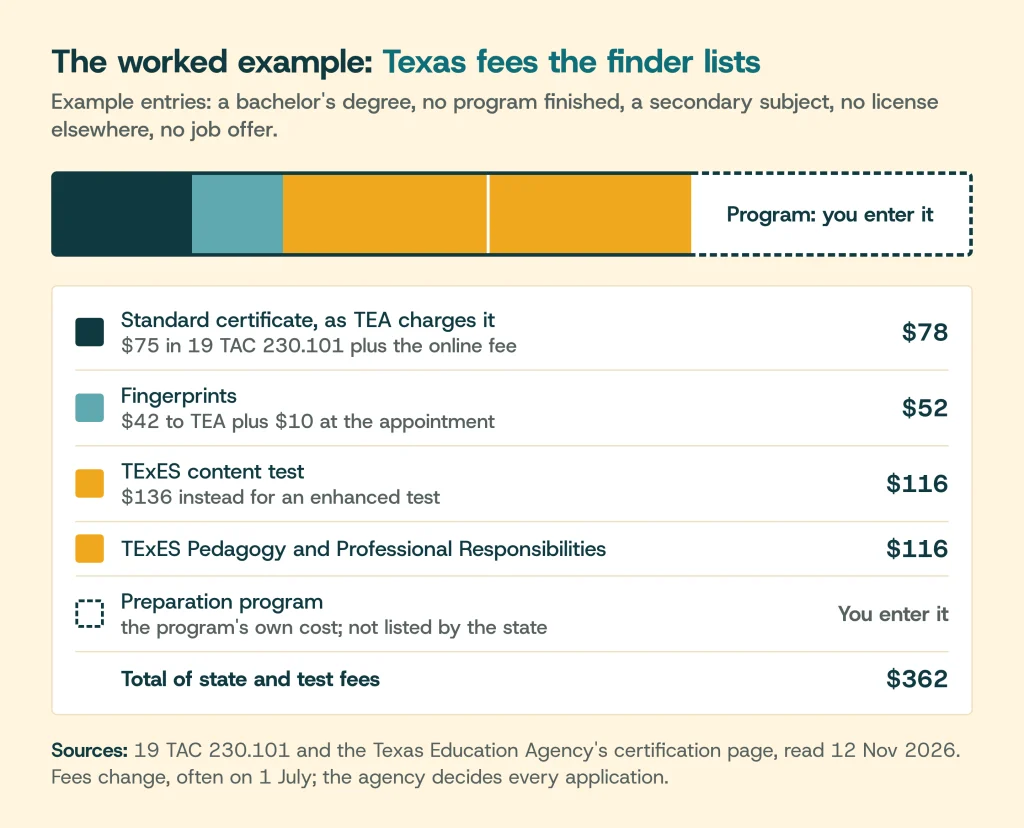
The finder opens on an example: Texas, a bachelor’s degree, no preparation program finished, a secondary subject, no license elsewhere, no job offer. It shows:
- Traditional: the Standard certificate after an approved program. Not met by your entry (no program finished).
- Alternative: an alternative program that admits holders of a bachelor’s with a 2.50 GPA and 12 subject hours or a content test. Met by your entry, as far as the degree goes; the GPA and hours are on the “can’t check” list.
- Apprenticeship: not confirmed for Texas in the rules read.
- Emergency: the emergency permit, $55 in rule (19 TAC 230.101); its stated minimums are not confirmed, so the finder says “not confirmed for this state: ask the agency”.
- Out-of-state: the $164 review. Not met (no license held elsewhere).
- Substitute: no state certificate; districts decide.
- Tests: a TExES content test ($116, or $136 for an enhanced test) and Pedagogy and Professional Responsibilities, $116 (19 TAC 230.101).
- Agency: TEA; standard certificate $78 with the online fee; fingerprints $42 plus $10.
Change the state to New Jersey and the same entries give “met” for the Certificate of Eligibility and for the substitute credential (30 credits). Change the degree to an associate and the Certificate of Eligibility turns to “not met”, while the substitute line stays “met”. The Texas teacher certification page sets out the Texas routes in full.
Claims you may see elsewhere
- “California requires the CBEST.” Since SB 153 of 2024, a bachelor’s degree from a regionally accredited institution meets California’s basic skills requirement for most credentials (Ed. Code 44252(b)(12), read 12 Nov 2026).
- “Some states give full reciprocity with no extra requirements.” Among the 14 states here, each still decides the equivalent license and runs its own checks and fees. Oklahoma accepts a standard license with no extra tests for the same areas, and New York’s endorsement needs no New York exams after 3 years rated effective; neither is a blanket rule for every license.
- “The compact lets you teach in any member state now.” The Interstate Teacher Mobility Compact covers member states only, and only an unencumbered license. As read on 13 Nov 2026, it had 14 members; Pennsylvania, Nebraska and Utah publish a compact route, Colorado issues a 30-day license until it starts, Kentucky’s page says compact-state holders apply through the compact, and the other members’ pages read show no compact route (teachercompact.org and state pages).
- “Every state requires the Praxis.” There is no national test. Of the 14 states here, California, Georgia, Illinois, Michigan, New York, Ohio, Texas and Washington name their own state tests for content, Florida names the FTCE, and Oklahoma names the OSAT while accepting Praxis subject tests as equivalents (each state’s agency and test pages, read 12 Nov 2026).
Your next step
- Open your state’s agency page from its fold-out above and read the route’s own page in full, including its exceptions.
- Check any program on the state’s own approved list before you pay; the fold-outs link each list.
- Have ready: official transcripts, any out-of-state license and a letter verifying your years taught, test score reports, and a fingerprint appointment once the agency tells you how to book it.
- Register for tests only on the vendor’s own site, after checking which test your state names for your area: see Praxis fees and passing scores for the Praxis states.
- Moving states? Read the receiving state’s fold-out above and its out-of-state page, then ask that agency which equivalent license it would issue.

Rules and fees checked on 13 November 2026. State agency pages read 11-12 November 2026 unless a later date is shown; statutes and rules cited with 13 November were re-read that day.
Formulas and sources
- State chosen: Cited per state on this page
- Checks left: Cited per state on this page
- Level map for tests: Cited per state on this page
- Tests named: Cited per state on this page
- Traditional route listed: Cited per state on this page
- Traditional route status: Cited per state on this page
- Alternative route listed: Cited per state on this page
- Alternative route status: Cited per state on this page
- Apprenticeship listed: Cited per state on this page
- Apprenticeship status: Cited per state on this page
- Out-of-state route listed: Cited per state on this page
- Out-of-state route status: Cited per state on this page
- Emergency route listed: Cited per state on this page
- Emergency route status: Cited per state on this page
- Substitute route listed: Cited per state on this page
- Substitute route status: Cited per state on this page
Sources
- Commission on Teacher Credentialing (CTC)
- CTC credential lookup
- CTC dashboard
- CL-402A
- CL-561
- CL-505p
- Colorado Department of Education (CDE)
- CDE credential search
- CDE program search
- Florida Department of Education (FLDOE)
- FLDOE list
- s. 1012.56(2)
- s. 1012.555
- Georgia Professional Standards Commission (GaPSC)
- GaPSC certification lookup
- GaPSC non-traditional preparation page
- Illinois State Board of Education (ISBE)
- ISBE program list
- Michigan Department of Education (MDE)
- MOECS public search
- MOECS program list
- NJDOE Office of Certification and Induction
- NJEdCert
- CEAS providers
- CE providers
- N.J.A.C. 6A:9B-5.6
- NYSED Office of Teaching Initiatives
- certificate holder search
- Inventory of Registered Programs
- Transitional B
- endorsement
- NYSED substitute page
- NC Department of Public Instruction (DPI)
- DPI licensure system
- DPI list
- G.S. 115C-270.20(a)(3)
- State Board of Education
- CORE public lookup
- ORC 3319.26
- ORC 3319.226
- ORC 3319.102
- Oklahoma State Department of Education (OSDE)
- educator search
- OEQA
- Alternative Placement Program
- OSDE emergency guidance
- Pennsylvania Department of Education (PDE)
- PDE list
- Texas Education Agency (TEA)
- TEA certificate lookup
- TEA consumer information on preparation programs
- 19 TAC 227.10
- Tex. Educ. Code 21.0521
- OSPI
- PESB list
- alternative routes
- WAC 181-79A-257
- ETS Praxis Information Bulletin 2026-27
- Interstate Teacher Mobility Compact (teachercompact.org)
- GaTAPP admission requirements
- MDE alternative routes to teacher certification
- OAC 3302-24-05