Florida’s teaching license is called an educator’s certificate, and the Florida Department of Education’s Bureau of Educator Certification issues it. Some applicants go straight to the five-year renewable Professional Certificate; others start on a Temporary Certificate, valid for five school years, issued once and not renewable, and move up to the Professional Certificate by passing the Florida Teacher Certification Examinations (FTCE) and finishing a preparation route the state accepts. The state charges $75 per subject to apply and $75 to upgrade from Temporary to Professional; the FTCE costs $130 for General Knowledge, $150 for Professional Education and $150 for most Subject Area Examinations. Those figures come from the department’s fee schedule and State Board of Education Rules 6A-4.0012 and 6A-4.0021, read on 13 November 2026. This page is one of our certification by state guides.
This page is general information, not legal or career advice. Each state’s licensing agency decides every application, and rules, tests and fees change, often on 1 July. Confirm the current rules with the agency before you pay for a program, a test or fingerprints.
Rules as read on 13 November 2026: section 1012.56, Florida Statutes (2026 edition, the main certification law), the related sections named below, Rules 6A-4.0012 (effective 25 August 2026) and 6A-4.0021 (effective 20 October 2026) in the Florida Administrative Code, and the Bureau of Educator Certification’s own pages. Florida uses the word certification; when people search for a Florida teaching license or teaching credential, this certificate is what they mean.
Certificate levels
Florida issues a certificate covering one or more subjects (the state’s word for a teaching area such as Elementary Education K-6 or Mathematics 6-12). There are two main levels, plus a temporary apprenticeship certificate for people without a bachelor’s degree.
| Certificate | Valid for | Renewable | Leads to |
|---|---|---|---|
| Temporary | 5 school fiscal years | No, issued once | Professional |
| Professional | Up to 5 years | Yes | (top level) |
| Temporary apprenticeship | 5 school years | No, issued once | Professional, after a bachelor’s |
Temporary Certificate. It gives time to finish the Professional requirements while teaching full time. Under section 1012.56(7)(b) it needs the basic requirements in 1012.56(2)(a)-(f): age 18 or over, a signed affidavit, a bachelor’s degree with at least a 2.5 grade point average in the major, background screening, good moral character and competence. It also needs the subject knowledge set in rule. FLDOE’s Certificate Types and Requirements page says subject knowledge is shown by a passing Subject Area Examination, or by meeting the subject’s coursework (“specialization”) with a 2.5 GPA (read 13 Nov 2026).
Two conditions affect timing. First, the Temporary Certificate is not issued until you are employed in a Florida public school, or in a nonpublic school with a state-approved program for demonstrating professional education competence, and your fingerprints have cleared (FLDOE Step 3 and Step 4, read 13 Nov 2026). Second, it cannot be issued twice. FLDOE’s upgrade page says State Board rules do not allow “back-to-back” Temporary Certificates (read 13 Nov 2026). Section 1012.56(7)(e) adds that a Temporary holder is assigned a teacher mentor for at least two school years after starting work.
Professional Certificate. This is Florida’s highest educator certificate. Under 1012.56(2) and (7)(a) it needs everything above plus three “mastery” requirements: general knowledge, subject area knowledge, and professional preparation and education competence. Each one has several accepted ways to meet it, set out in the sections below. Section 1012.56(7)(a)2 adds a separate grades 6-12 route for a teacher with a master’s or higher degree in a STEM field who teaches a high school course in that subject, is rated highly effective, and passes the Professional Education Test.
Moving up from Temporary to Professional. FLDOE’s upgrade page (read 13 Nov 2026) says:
- You apply online.
- The upgrade application stays valid for one year after the bureau receives it.
- The holder is expected to finish every Professional requirement before the Temporary Certificate expires.
- The bureau may issue the Professional Certificate to follow straight on from the Temporary one if everything, including the application, is finished by 30 June of the year after the Temporary Certificate expires.
The same page warns that this window does not protect a job: the employing district may want the requirements finished sooner to renew a teaching contract. Ask the district what its own deadline is.
Other certificates. Florida also issues athletic coaching, adjunct and restricted classical education certificates, which this page does not cover. FLDOE’s site lists them.
Routes Florida lists
FLDOE’s Certificate Pathways and Routes page sorts the routes into three groups (read 13 Nov 2026):
- Straight to the Professional Certificate. Some applicants never hold a Temporary Certificate.
- To a Temporary Certificate first. Others start here.
- From Temporary to Professional. The ways a Temporary holder upgrades while teaching.
Which route fits a person is decided by the bureau’s evaluation, not by the applicant. Our teaching route finder sets Florida’s stated minimums next to your own entries.
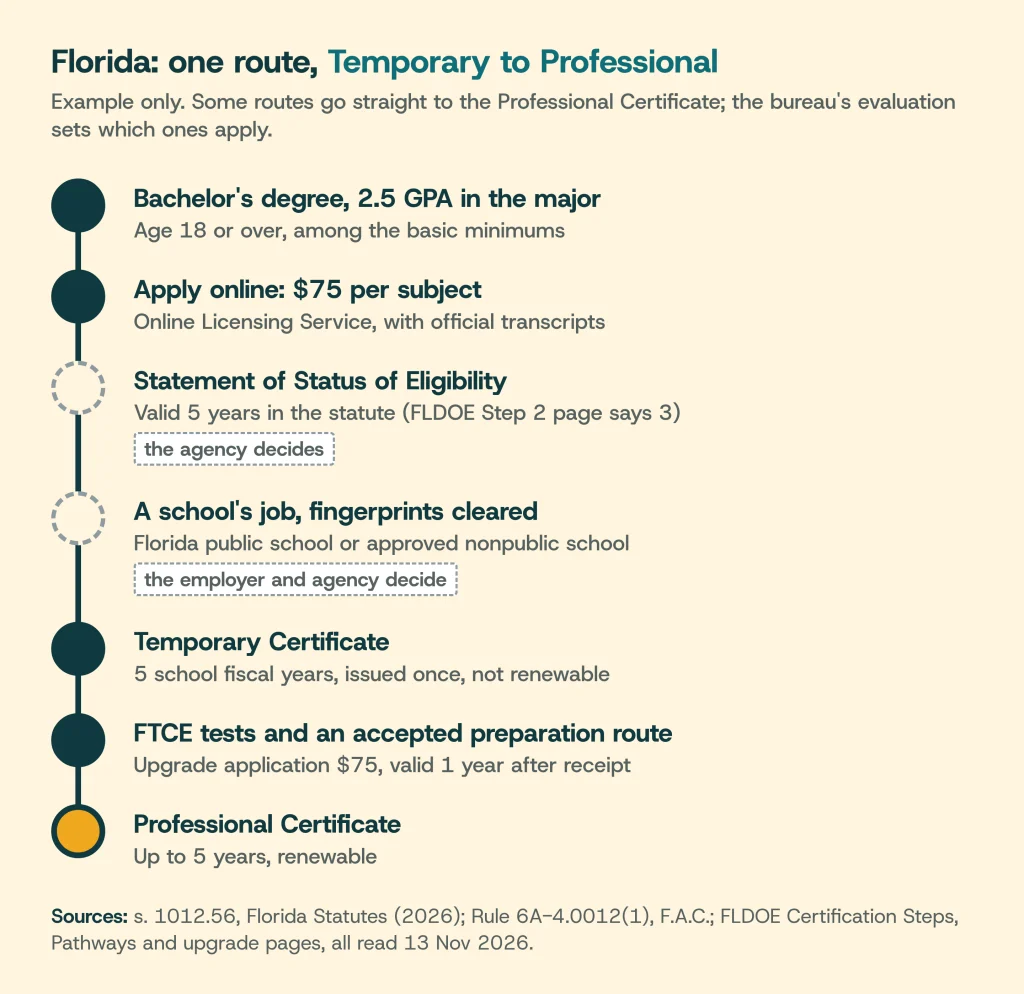
The statement of eligibility. Every route starts with the same evaluation. The bureau reviews the complete application and sends an Official Statement of Status of Eligibility. The statement says whether the applicant is eligible for a Temporary or Professional Certificate in each subject requested, and lists every way to finish what is missing (1012.56(1)(c)). The bureau only evaluates the subjects you request.
Section 1012.56(1) gives the time limits:
- Professional Certificate or statement: issued within 90 calendar days of a complete application.
- Temporary Certificate: issued within 14 days of an employer’s request.
- Statement of eligibility: valid for 5 years.
FLDOE’s Step 2 page, read the same day, still says three years for the statement’s validity. Go by the expiry date printed on your own statement. If it runs out before you are hired, you reapply under the rules then in force.
Direct to the Professional Certificate. FLDOE’s pathways page lists five routes:
- A valid standard certificate from another state.
- A valid National Board (NBPTS) certificate.
- A teacher education degree program plus passing Florida tests.
- An Educator Preparation Institute program plus passing Florida tests.
- Two semesters of full-time college teaching, plus the Professional Education Test and the Subject Area Examination for a bachelor’s-level subject.
Educator Preparation Institutes (EPIs). Section 1004.85 lets accredited colleges and qualified private providers offer competency-based programs for bachelor’s degree holders who were not education majors. On FLDOE’s EPI page, completing one leads to an initial Professional Certificate (read 13 Nov 2026). Section 1012.56(7)(a)3 says an EPI completer rated highly effective does not have to pass the Professional Education Test to get the Professional Certificate.
To a Temporary Certificate. FLDOE’s pathways page lists these with a bachelor’s degree:
- a passing Florida Subject Area Examination (for subjects needing no more than a bachelor’s);
- a valid certificate from the American Board for Certification of Teacher Excellence (ABCTE), as FLDOE names it;
- a major in the content area; or
- the required courses with a 2.5 GPA in the content area.
For a career changer, FLDOE’s career changer page says to apply for a Temporary Certificate in the chosen subject. It adds that for most subjects needing only a bachelor’s major, a passing Subject Area Examination meets the subject requirement for a Temporary Certificate in that subject (read 13 Nov 2026). Our guide to becoming a teacher without a teaching degree sets this beside other states’ routes.
Professional Learning Certification Programs (PLCPs). This is Florida’s main alternative certification route for people already teaching. Section 1012.56(8) lets school districts, charter schools and charter management organizations run competency-based programs, and participants must hold a Temporary Certificate. Each program includes mentoring and induction, an assessment of teaching, and preparation content, and requires passing the Subject Area and Professional Education tests. Candidates who entered a program in 2022-23 or later in certain reading-related subjects also complete the reading endorsement. FLDOE’s PLCP page notes these were formerly called Professional Development Certification Programs (read 13 Nov 2026), and its pathways page still uses the old name. Like EPI completers, a PLCP completer rated highly effective does not have to pass the Professional Education Test (1012.56(7)(a)3).
Other ways to upgrade. The pathways page also lists:
- an ABCTE certificate plus shown competence in the classroom;
- college professional-training options or professional preparation courses, plus teaching experience, a school’s competence program and the Florida tests;
- the STEM master’s route described above.
Section 1012.56(6)(f) and (9) describe the classroom route: preparation courses set in rule, a school’s professional education competence program, and three years rated effective or highly effective while holding a Temporary Certificate.
Temporary apprenticeship certificate. Section 1012.555 sets up the Teacher Apprenticeship Program. Its minimums are:
- an associate degree with a 2.5 GPA in that degree program;
- a passed background screening;
- a temporary apprenticeship certificate under 1012.56(7)(d).
The apprentice is appointed by the district school board as an education paraprofessional. The apprentice commits to at least the first two years in a mentor teacher’s classroom, and completes at least two years before applying for a Professional Certificate. The section says completing the program does not exempt the apprentice from the bachelor’s degree requirement in 1012.56(2)(c). FLDOE’s apprenticeship and internship page adds that the applicant needs a valid Statement of Status of Eligibility, must be selected by a participating employer, and must be accepted by the Florida college or university that provides the program’s related instruction for that employer (read 13 Nov 2026). In other words, the route depends on an employer’s selection. Our guide to moving from paraprofessional to teacher covers routes like this.
Temporary internship certificate and the military route. Section 1012.56(7)(b) also allows a Temporary Certificate, without a finished bachelor’s degree, in two cases:
- Internship. Someone enrolled in a state-approved teacher preparation program who is doing the program’s field experience or internship at a public school. They need 60 college credits with a 2.5 GPA and the subject requirements.
- Military. For subjects that otherwise need a bachelor’s, someone with 48 months of active-duty service and an honorable discharge or medical separation, plus 60 college credits with a 2.5 GPA and the subject requirements.
FLDOE’s internship guidance adds that applicants must pass a Florida Subject Area Examination for a bachelor’s-level subject. The statute’s own notes say the paragraph was last amended effective 1 July 2026 (chapter 2026-106). It will change again on 1 July 2029: the internship route will then cover only the final semester of clinical experience before graduation (chapter 2025-107).
Approved program lists. FLDOE publishes three, read 13 Nov 2026:
- state-approved college and university programs;
- approved EPIs, from the EPI page;
- approved PLCPs, from the PLCP page.
We don’t rank or recommend any program. Section 1012.56(8)(c) says a PLCP counts toward the Professional Certificate only if the department has approved it. Check a program on the state’s list before you enrol; our guide to checking a teacher prep program’s approval shows how.
Tests: the FTCE
Florida uses its own tests, the Florida Teacher Certification Examinations, not the Praxis. FLDOE’s FTCE page says the tests are delivered by the Evaluation Systems group of Pearson, and registration is on the FTCE program site (read 13 Nov 2026). Rule 6A-4.0021, effective 20 October 2026, sets the fees and passing scores. Its fee table has applied since 22 April 2019.
| Test | Full test | Per part | Passing score |
|---|---|---|---|
| General Knowledge (4 subtests) | $130 | $32.50 a subtest | Scaled 200; essay raw 6 |
| Professional Education | $150 | – | Scaled 200 |
| Subject Area Examination (most) | $150 | – | Not confirmed |
| Elementary K-6; PreK/Primary PK-3 | $150 | $37.50 a subtest | Not confirmed |
| English 6-12; Middle Grades English 5-9 | $150 | $75 a section | Not confirmed |
Other rules from 6A-4.0021, read 13 Nov 2026:
- Retakes. A failed test can be retaken once at least 30 days have passed since the last attempt.
- Refunds. Fees are refunded only on a written request that reaches the testing agency at least 24 hours before the test. Missing or not finishing the test forfeits the fee.
- Fee waivers. First-time test fees are waived for members of the armed forces or a reserve component who serve or have served on active duty, and their spouses; surviving spouses of members who died on active duty; honorably discharged veterans and their spouses or surviving spouses; and retired law enforcement officers, firefighters, EMTs and paramedics. The request goes through FLDOE’s certification fee waiver site with documents (section 1012.59(3) and the rule’s sections 13 and 14).
Whether the testing vendor adds its own registration charges on top of the rule’s fees is not confirmed in official text. Check the total at registration. Our certification tests by state page sets the FTCE beside other states’ tests.
Ways to meet General Knowledge without the test. Section 1012.56(3) accepts any of these:
- a valid professional standard teaching certificate from another state;
- a valid National Board certificate;
- two semesters of college teaching;
- a master’s or higher degree from an accredited institution;
- passing scores on the GRE, SAT, ACT or Classic Learning Test, as set in rule.
Rule 6A-4.0021(12) sets those scores, which must have been earned in the 10 years before applying. GRE scores count from tests taken on or after 1 July 2015, and SAT, ACT and CLT scores from tests on or after 1 March 2016. A passing score is needed for each of the four General Knowledge areas:
| GK area | GRE | SAT | ACT | CLT |
|---|---|---|---|---|
| Essay | Writing 4 | EBRW 560 | English 22 | Verbal + Grammar 49 |
| English Language Skills | Verbal 151 | EBRW 560 | English 22 | Verbal + Grammar 49 |
| Reading | Verbal 151 | EBRW 560 | Reading 23 | Verbal + Grammar 49 |
| Mathematics | Quant 147 | Math 540 | Math 22 | Quant 20 |
The statute also waives General Knowledge for a teacher who has been given three years of district supports and has been rated effective or highly effective in each of the last three years (the paragraph after 1012.56(3)(f)). On 1 July 2029 chapter 2025-107 swaps the GRE, SAT, ACT and CLT option for approved courses in introduction to education and classroom management. The same chapter also rewrites the professional preparation options from that date, including the EPI and PLCP routes to the Professional Certificate described above.
Subject area and professional education. Section 1012.56(5) and (6) list the ways to meet each one:
- Subject area knowledge. Usually the Subject Area Examination. Other options include another state’s valid professional standard certificate, an NBPTS certificate, a master’s in the subject for bachelor’s-level subjects, or, where Florida has no test of its own, a standardized test named in rule, such as the ACTFL language proficiency tests.
- Professional preparation. Usually an approved program plus the Professional Education Test. Other options include another state’s standard certificate or an NBPTS certificate.
Fees and fingerprints
The state’s application fees come from Rule 6A-4.0012, effective 25 August 2026, and FLDOE’s Certification Application Fee Schedule, both read 13 Nov 2026. They are nonrefundable. The fee schedule treats an application as initial, at $75 per subject, when you have never held a Florida certificate, hold a different type, or your Florida certificate expired more than a year ago.
| Application | Fee |
|---|---|
| Initial certificate (Temporary or Professional) | $75 per subject |
| Upgrade, Temporary to Professional (Temporary valid or expired within the past year) | $75 |
| Add a subject or endorsement | $75 per subject |
| Renewal of a Professional Certificate | $75 |
| Late renewal (expired within the past year) | $105 ($75 + $30) |
| Reinstatement of an expired Professional | $75 per subject |
| Remove a subject; name change; duplicate | $20 each |
| Fingerprints and background screening | Not confirmed: set by the district or vendor |
FLDOE’s Apply page says online payments are by Visa or MasterCard and the department does not accept cash. Its Step 1 page also allows a cashier’s check, personal check or money order, and lists a $30 fee if a personal check is returned (both read 13 Nov 2026). The same waivers as for the tests apply to application fees: section 1012.59(3) and Rule 6A-4.0012(8) and (9) cover service members, veterans and their spouses, and retired first responders. Section 1012.59(4) also waives the initial Subject Area Examination fee and the certification fees for a Temporary or Professional holder in Exceptional Student Education K-12 who adds Elementary Education K-6, or the reverse.
Fingerprints. Everyone seeking certification is fingerprinted and screened by the Florida Department of Law Enforcement and the FBI. The statute moves the screening to the state’s Care Provider Background Screening Clearinghouse from 1 January 2025, or a later date set by the Agency for Health Care Administration. Certificate holders are rescreened every five years. The cost may be borne by the employer or the employee (section 1012.56(11), read 13 Nov 2026). Florida publishes no single fingerprint price. FLDOE’s fee page says applicants may pay a processing fee, retention fees and charges set by districts and Livescan providers, and that public and approved nonpublic school employees should ask their employer. FLDOE’s Step 4 page warns that prints taken before you have a Florida job may have to be redone, at a second fee, when a public or charter school hires you (read 13 Nov 2026).
Once prints clear, the Step 4 page says the certificate is issued within 30 days of the bureau receiving the request or the cleared records. If the screening shows a record, or the applicant reported one, the file goes to FLDOE’s Professional Practices Services for review. We don’t comment on how any record or case is weighed. That is decided by the department, and a denial can be reviewed by the Education Practices Commission (1012.56(13)).
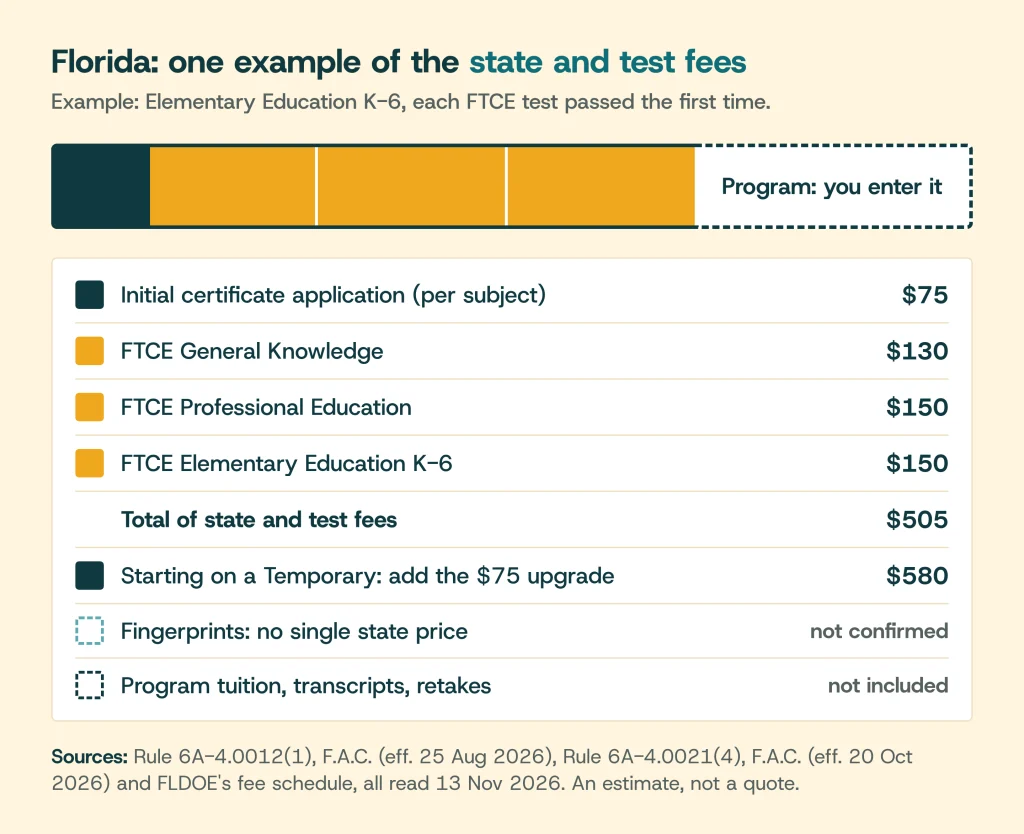
Example: what the state and test fees add up to. An Elementary Education K-6 applicant who passes each test the first time pays:
- $75 initial application;
- $130 General Knowledge;
- $150 Professional Education;
- $150 Elementary Education K-6.
That is a total of $505. Starting on a Temporary Certificate and upgrading later adds the $75 upgrade fee, for $580. Fingerprints are not included because Florida sets no single state price. The figures are as read on 13 Nov 2026, and program tuition, transcripts and retakes are extra. This is an estimate, not a quote. Our teacher certification cost calculator lets you change each line and add your own fingerprint and program costs.
Moving to Florida with a license
FLDOE’s reciprocity page lists two routes to the Professional Certificate for teachers certified elsewhere (read 13 Nov 2026):
- A valid standard certificate from another state. It must be comparable to a Florida Professional Certificate, in a subject comparable to a Florida subject, and require the same or a higher level of training. It must also be currently valid, not expired or revoked.
- A valid NBPTS certificate. The Florida certificate shows the Florida subject FLDOE treats as comparable.
You apply for the Professional Certificate in the same subjects shown on the out-of-state or National Board certificate. If you no longer hold a valid certificate, the page says to apply for a Temporary Certificate in your degree major or program subject instead. Section 1012.56(3)(b), (5)(e) and (6)(c) back this up: another state’s valid professional standard certificate meets the general knowledge, subject area and professional preparation requirements.
FLDOE’s Step 1 page asks for a copy of the front and back of every valid certificate you hold. The copy must show the certificate’s title and level, its subjects and grade levels, its validity dates, and your name and identification number. If the certificate uses codes, attach a list explaining them. You still need the Florida application, the $75 per subject fee, official transcripts and Florida fingerprints. Out-of-state certificates cannot be used to renew a Florida Professional Certificate later (FLDOE renewal page, read 13 Nov 2026).
The teacher compact. Florida is a member of the Interstate Teacher Mobility Compact: section 1012.993, enacted by chapter 2023-165 (read 13 Nov 2026). The compact’s official map, read on 13 November 2026, lists 14 member states. Mississippi passed the compact but has not been admitted. Each member decides how it handles compact applications: as read, Pennsylvania, Nebraska and Utah publish a compact route, Colorado issues a 30-day license until it starts, Kentucky’s page says compact-state holders apply through the compact, and the other members’ pages read show no compact route. Florida is one of those: FLDOE’s reciprocity page, read 13 November 2026, lists the two routes above and no compact route. Florida is a member, and licenses were not yet issued under the compact there as read on 13 November 2026.
Florida’s text of the compact defines an “unencumbered” license as one that is not a restricted, probationary, provisional, substitute or temporary credential, and the compact route is built around that kind of license. A Florida Temporary Certificate is a temporary credential, so it falls outside that definition. The one stated exception is for active-duty military members and eligible military spouses, whose license need not be unencumbered (Article III(4) of section 1012.993). The commission next meets on 20 November 2026. The receiving state decides the equivalent license; our teaching license reciprocity checker shows Florida’s rule beside other states’.
Renewal and substitutes
Renewing the Professional Certificate. Section 1012.585 and FLDOE’s renewal page (both read 13 Nov 2026) set the rule:
- Renew every five years, with the application received before the certificate expires.
- Earn 6 semester hours of college credit, or 120 inservice points, or a mix, within the validity period. Twenty inservice points equal one semester hour.
- At least 1 semester hour must be in teaching students with disabilities.
- For each subject you keep, at least 3 of the hours must be in that subject. A passing Subject Area Examination counts as 3 semester hours for that subject, for renewal only. The reading credits below can be met only by college credit or inservice points.
- If the certificate’s validity began on or after 1 July 2020 and covers a reading-related subject (Elementary K-6, PreK-3, English 6-12, ESOL, Reading and others on FLDOE’s list), at least 2 college credits or 40 inservice points must be in science-of-reading instruction for students with characteristics of dyslexia. From validity dates of 1 July 2025 the list includes Exceptional Student Education K-12.
- A valid National Board certificate renews the Florida subject it matches.
Teachers employed by a Florida district renew through that district, which may charge up to the department’s fee (1012.585(1)). Others renew with the bureau through their online account.
Late renewal. If every renewal credit was finished before the certificate expired, a late application can still be filed. The application, the $75 fee and a $30 late fee must reach the bureau before 1 July of the year after the certificate expired (1012.585(2)(c) and FLDOE’s renewal page). After that, the route is reinstatement: 6 college credits or 120 inservice points earned in the five years before reinstating, at $75 per subject (1012.585(5)). Our certificate renewal guide compares renewal cycles across states.
Substitute teaching. Under section 1012.35 (read 13 Nov 2026), each district school board sets its own rules for hiring and paying substitutes. At a minimum, those rules require:
- fingerprints;
- a high school diploma or equivalent;
- an initial orientation and training program on school safety, liability, professional responsibilities and ethics.
Candidates with no prior teaching experience complete further training in classroom management and instructional strategies. Districts must assess the quality of substitutes who teach 30 or more days in a single classroom placement. Many districts ask for more than the minimum, so check with the district. Our guide on how to become a substitute teacher compares these rules with other states.
Pay for Florida teachers is set by districts. Our teacher salary by state page gives Florida’s figures from each source, labelled and kept apart.
Next steps

- Read the four steps on FLDOE’s Certification Steps page: application, statement of eligibility, employment, fingerprints.
- Apply in FLDOE’s Online Licensing Service, reached from its Apply page. FLDOE says a U.S. Social Security number is required before a certificate can be issued.
- Register for the FTCE on the FTCE program site. If one of the fee waivers above applies to you, request it first on the fee waiver site.
- Check a certificate with the Certificate Lookup that FLDOE links from its Educator Certification page.
- Read the law and rules yourself: section 1012.585 for renewal, section 1012.35 for substitutes, and Rules 6A-4.0012 and 6A-4.0021.
- Have ready: official transcripts from every college, sent electronically through FASTER or SPEEDE or mailed by the college (copies, emailed transcripts and PDFs are not accepted); copies of any out-of-state or National Board certificates; your test score reports; and, for the Temporary Certificate, a school’s job offer and that employer’s fingerprint instructions.
To set Florida beside other states, see teacher certification by state.
Rules and fees checked on 13 November 2026 against sections 1012.56, 1012.555, 1012.585, 1012.59, 1012.32, 1012.35, 1004.85 and 1012.993 of the 2026 Florida Statutes; Rules 6A-4.0012 and 6A-4.0021, F.A.C.; and the Florida Department of Education’s certification, preparation and FTCE pages. The compact’s status was read on 13 November 2026.
Sources
- Section 1012.56, Florida Statutes (2026): educator certification requirements
- Section 1012.555, Florida Statutes (2026): Teacher Apprenticeship Program
- Section 1012.585, Florida Statutes (2026): renewal and reinstatement
- Section 1012.59, Florida Statutes (2026): certification fees
- Section 1012.32, Florida Statutes (2026): qualifications of personnel
- Section 1012.35, Florida Statutes (2026): substitute teachers
- Section 1004.85, Florida Statutes (2026): educator preparation institutes
- Section 1012.993, Florida Statutes (2026): Interstate Teacher Mobility Compact
- Rule 6A-4.0012, F.A.C., Application Information (effective 25 August 2026)
- Rule 6A-4.0021, F.A.C., Florida Teacher Certification Examinations (effective 20 October 2026)
- FLDOE: Educator Certification
- FLDOE: Certificate Types and Requirements
- FLDOE: Upgrading from the Temporary to the Professional Certificate
- FLDOE: Certificate Pathways and Routes
- FLDOE: Teacher Apprenticeship and Internship Pathways
- FLDOE: Career Changer or College Graduate of a Non-education Program
- FLDOE: Certified Teacher or Administrator (reciprocity)
- FLDOE: Certification Steps (Steps 1 to 4)
- FLDOE: Certification Application Fee Schedule
- FLDOE: Renewal Requirements
- FLDOE: State-Approved Educator Preparation Programs
- FLDOE: Educator Preparation Institutes
- FLDOE: Professional Learning Certification Programs
- FLDOE: Florida Teacher Certification Examinations (FTCE)
- Interstate Teacher Mobility Compact Commission