
Texas teacher certification is issued by the State Board for Educator Certification (SBEC) and handled by the Texas Education Agency (TEA). For a first certificate, TEA lists five requirements: a bachelor’s degree, an approved educator preparation program (EPP), the TExES certification exams, a state application and fingerprinting. The standard certificate costs $78 as TEA charges it ($75 in 19 TAC §230.101(a)(2) plus an online payment supplement) and lasts five years. Fingerprinting costs $42 to TEA plus $10 to the fingerprint vendor. The main pedagogy exam, Pedagogy and Professional Responsibilities EC-12 (160), costs $116. All of this was read on 13 November 2026. This page is part of our teacher certification by state guides.
This page is general information, not legal or career advice. Each state’s licensing agency decides every application, and rules, tests and fees change, often on 1 July. Confirm the current rules with the agency before you pay for a program, a test or fingerprints.
Rules as read on 13 November 2026 come from three places: TEA’s certification pages, the SBEC rules in 19 Texas Administrative Code (TAC), Part 7, in the PDFs TEA posts, and Texas Education Code chapter 21. TEA notes that its rule PDFs are for information and that the official text is the Secretary of State’s Texas Administrative Code. Texas says “certificate”, not “license” or “credential”, so this page does too. A Texas teaching certificate is what other states call a teaching license.
Certificate levels
19 TAC §230.31 names the types of certificate. The ones a new classroom teacher meets:
| Certificate | Who holds it | Term | Rule |
|---|---|---|---|
| Intern | Alternative-route candidate teaching in a paid internship | 1 year; 2 years for alternative-program candidates from 2026-27 | §230.36 |
| Intern with preservice | Preservice alternative-route candidate | 1 year | TEC §21.0412 |
| Probationary | Candidate in a paid internship who has passed all exams, PPR included | 12 months | §230.37 |
| Standard | Met every requirement for the area | 5 years, renewable | §230.31(c) |
| Enhanced standard | Finished the residency route | 5 years, renewable | §230.39 |
| One-year | Certified in another state, Texas exams still owed | 1 year | §230.113(b) |
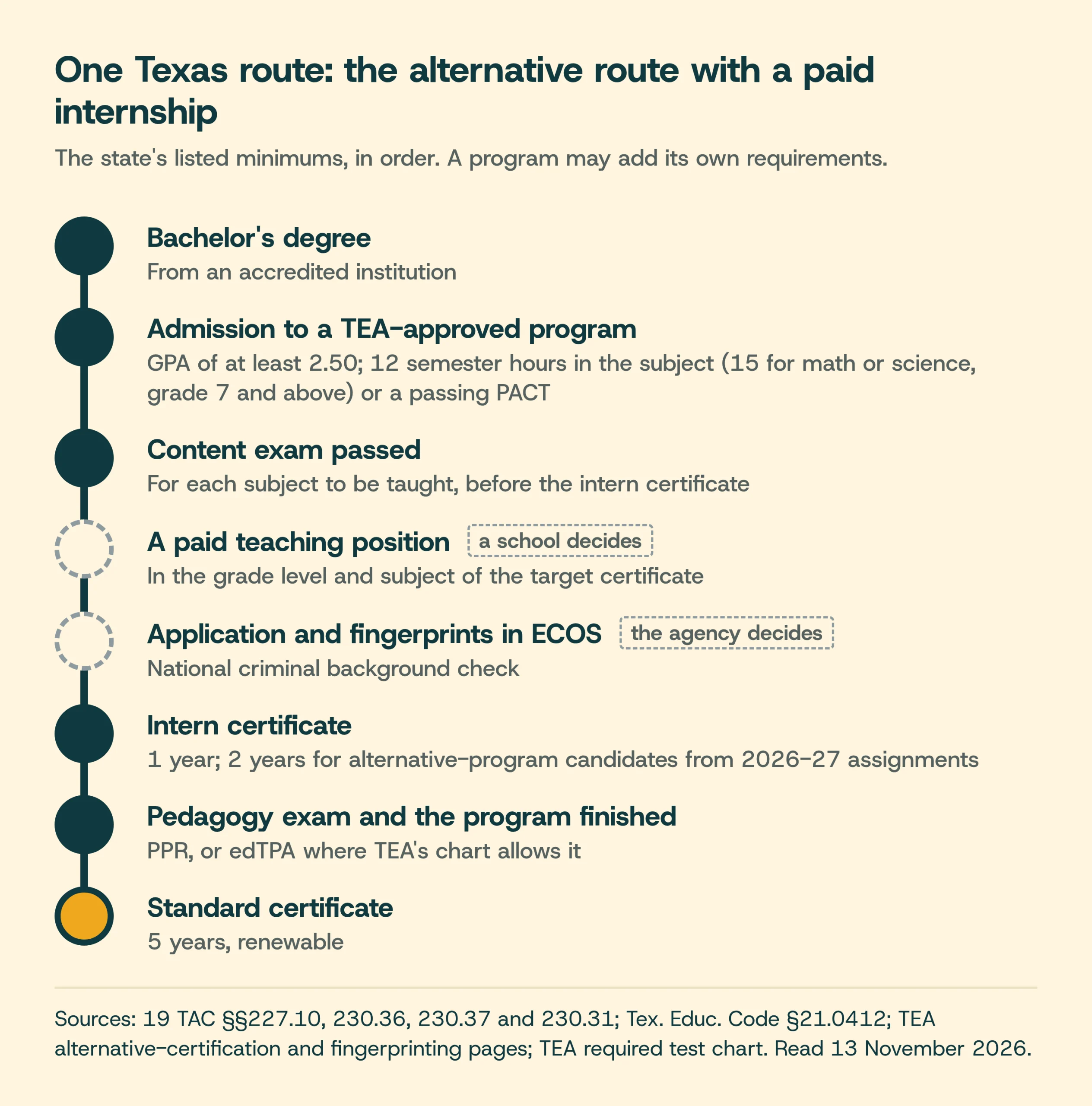
The intern term changed in 2026. Under 19 TAC §230.36(c)(3), as amended effective 2 August 2026, an intern certificate lasts one 12-month period, but intern certificates for alternative-program candidates (late hires included) are issued for two years beginning with assignments for the 2026-27 school year. The statute, Tex. Educ. Code §21.0412(a)(4), added by House Bill 2 (HB 2) in 2025, sets the two years. TEA’s alternative-certification page still described the intern or probationary certificate as “valid for one calendar year” when read on 13 November 2026. Before an intern certificate is issued for a classroom assignment, the candidate must pass the content exam for each subject to be taught (§230.36(d)). A probationary certificate also needs the pedagogy exam (§230.37(d)(2)).
A limit on temporary certificates. Before a standard certificate, a person may not serve more than three 12-month periods on any mix of intern, probationary and one-year certificates and emergency permits (19 TAC §230.36(c)(4) and §230.37(c)(4)). An intern or probationary certificate becomes inactive 30 calendar days after the holder leaves the school assignment or the program. Certificates issued before 1 September 1999 (provisional and professional) are valid for life (§230.31(b)). An emergency permit is requested by a school district, and the district pays its $55 fee (§230.99(b), §230.101(a)(8)).
Routes the state lists
HB 2 (2025) told the SBEC to set three kinds of preparation route, now in Tex. Educ. Code §§21.04421 to 21.04423, read 13 November 2026:
- Traditional (university) route (§21.04421): the candidate may earn an undergraduate or master’s degree and the certificate together, with “substantial preservice practice” in a prekindergarten to grade 12 classroom. Students apply while enrolled at an accredited college (19 TAC §227.10(a)(1)). TEA’s university-program page also describes post-baccalaureate programs for people who already hold a degree.
- Residency route (§21.04422): at least one full school year of preservice practice in a prekindergarten to grade 12 classroom. It leads to the enhanced standard certificate (19 TAC §230.39).
- Alternative route (§21.04423): for people who already hold a degree. There are two kinds: a preservice alternative route with substantial classroom practice first (time as a paraprofessional may count), and a flexible alternative route. TEA says many alternative programs can be finished in a year, often with a paid internship. More on how the Texas alternative route works.
Minimums to enter any approved program are set in 19 TAC §227.10 (amended effective 2 August 2026). A program may add its own requirements, but it may not ask for less than these:
- A bachelor’s degree from an accredited institution for the alternative and post-baccalaureate routes, or current enrolment at one for the university route (§227.10(a)(1)-(2)).
- A grade point average of at least 2.50, counted on all coursework or on the last 60 semester credit hours (§227.10(a)(3)). A program director may make an exception for up to 10% of an incoming class. The person then has to show equivalent work experience and pass the content exam before admission.
- For classroom teachers: 12 semester credit hours in the subject, or 15 for mathematics or science at grade 7 and above, or a passing score on a Pre-Admission Content Test (PACT) (§227.10(a)(4)).
- Basic skills in reading, writing and mathematics under the Texas Success Initiative rules, plus English proficiency (§227.10(a)(6)-(7)), an application and a screening (§227.10(a)(8)-(9)).
A job offer is part of the internship routes. An intern or probationary certificate is valid only while its holder serves “an acceptable, paid internship supervised by the EPP” (19 TAC §230.36(c)(1), §230.37(c)(1)). TEA’s alternative-certification page says the candidate must secure a teaching assignment in the grade level and subject of the target certificate. The program may help, but the hiring decision belongs to a school. TEA’s page also says some programs offer unpaid clinical teaching instead of a paid internship.
The approved-program list. According to TEA, only programs on its approved list can recommend a person for a Texas certificate. TEA publishes the list as an interactive EPP map, with a filter for alternative programs. It also publishes its own accreditation ratings for every program on the Accountability System for Educator Preparation (ASEP) dashboard and pass-rate data on its consumer information page. All three were live when read on 13 November 2026. We link TEA’s own pages and do not rebuild or rank them. Our guide on checking that a program is state-approved shows how to use them.
Teaching without a certificate is closing. Under Tex. Educ. Code §21.0032 (HB 2), a district may not employ a teacher of record for a foundation-curriculum course (English language arts and reading, mathematics, science, social studies) who lacks the right certificate or permit. TEA’s HB 2 page, read 13 November 2026, phases this in: kindergarten to grade 5 reading and mathematics teachers from 2026-27, and all foundation-subject teachers from 2027-28. Districts with an approved delay plan have until the start of 2029-30 (§21.0032(a-1)), and TEA listed 572 such districts. Districts may still use waivers and school district teaching permits (§21.055). A teacher on such a permit “is not certified by the SBEC”, in TEA’s words.

Tests: TExES and the rest
Texas uses its own exams, the Texas Examinations of Educator Standards (TExES), run by Pearson for TEA. The exams each certificate needs are set in the figure at 19 TAC §230.21(e) and summarised in TEA’s required test chart (May 2024 edition). A first classroom certificate needs a content exam for the area plus a pedagogy exam. For prekindergarten to grade 6 areas, the Science of Teaching Reading (STR) exam is also required (Tex. Educ. Code §21.048(a-2)). Fees below are from the Texas Educator Certification Examination Program exam pages and match 19 TAC §230.101(c)-(d), read 13 November 2026.
| Exam | Who takes it | Fee | Pass |
|---|---|---|---|
| PPR EC-12 (160) | Most first classroom certificates | $116 | 240 |
| Science of Teaching Reading (293) | PK-3, EC-6 and listed grade 4-8 areas | $136 | 240 |
| Core Subjects EC-6 (391) | Elementary generalists | $116; $58 per subject exam taken separately | 240 on each of 5 subject exams |
| Other content exams | The certificate area | $116 or $136 (enhanced) | 240 |
| Pre-Admission Content Test | Before entering a program | $106 | not confirmed |
- A processing fee on top. Pearson’s payment page says a non-refundable Texas.gov processing fee is added to each exam fee. The page does not give the amount, so it is not in our totals. A registration lapses without refund if the exam isn’t taken within 170 days.
- Program approval first. Candidates in a program can test only when the program approves it (19 TAC §230.21(b)). TEA says the approval covers one attempt at a time. PACT is the exception: it is for people with a bachelor’s degree who were never admitted to a Texas program, and TEA says it is not a certification exam.
- Five attempts. A person may not retake an exam more than four times (Tex. Educ. Code §21.048(a-1); 19 TAC §230.21(a)), and must wait 30 days between attempts. For Core EC-6, each testing session counts as an attempt, whether for the whole exam or one subject exam (§230.21(a)(1) and the program’s retake policy). A waiver for good cause costs $160 and needs set hours of study (§230.21(a)(2), (5)).
- edTPA in some fields. TEA’s chart lists an edTPA portfolio as an alternative to the PPR in many fields ($311, edTPA page on tx.nesinc.com).
- Fee waivers. Under Tex. Educ. Code §21.0411 (HB 2), the first attempt at the matching exam and the certificate application fee are waived for special education and bilingual education certificates. TEA’s HB 2 page lists the areas (Special Education Specialist EC-12 (186), Deafblind, Deaf and Hard of Hearing, Visual Impairments, and Bilingual Education Supplemental in six languages) and says the exam waiver applies to first attempts taken on or after 4 June 2025 and is applied at registration. The application fee waiver covers intern, probationary and standard certificate applications made through a Texas educator preparation program or by adding a certificate by exam, and a program’s candidate must first be recommended by the program; the out-of-state Review of Credentials fee is not on TEA’s list, as read on 13 November 2026.
- Changes ahead. TEA says Core Subjects EC-6 (391) will last be offered on 31 August 2027, and its scores can be used for certification until 1 September 2028, with new Core EC-6 exams (810-815) planned no earlier than September 2027. A new Texas Test of Educator Proficiency (T-TEP) is also planned no earlier than September 2027, pending SBEC action. A program may not admit a candidate into an area whose exam or certificate is set to expire within one calendar year of admission unless the program is approved for the next version (19 TAC §227.10(d)(3)).
Other states’ tests compared: teacher certification tests by state.
Fees and fingerprints
Certificate fees are set in 19 TAC §230.101(a) (rule last amended effective 19 May 2024). §230.103 adds an “e-pay supplemental fee” for the state’s online portal, which is why TEA’s totals run a few dollars higher than the rule. The figures below were read on 13 November 2026.
| Fee | Amount | Source |
|---|---|---|
| Standard certificate | $78 ($75 in rule) | TEA out-of-state checklist and HB 2 page; §230.101(a)(2) |
| Intern or probationary certificate | $75 in rule, plus the supplement | §230.101(a)(4) |
| Review of out-of-state credentials | $164 ($160 in rule), non-refundable | TEA checklist; §230.101(a)(6) |
| One-year certificate | $52 ($50 in rule) | TEA checklist; §230.101(a)(7) |
| Fingerprinting | $42 to TEA ($40 + $2 card processing fee), then $10 to IdentoGO | TEA fingerprinting page |
| Renewal, on time | $20 in rule; $10 more if late | §230.101(a)(15), (17) |
Fingerprints. Every first-time applicant is fingerprinted for a national criminal background check, started from the application in ECOS (TEA’s online certification system). After paying the $42 in ECOS, the applicant gets an email from IdentoGO to book an appointment, then pays $10 more at the appointment. TEA says results usually arrive in 5 to 7 business days. Applicants outside Texas can instead ask for fingerprint cards. They pay any fee the local police agency charges plus $10 to IdentoGO, and TEA says this takes at least four weeks. TEA adds that the employing district may still require digital fingerprints later, and that some IdentoGO locations outside Texas offer digital fingerprinting for an additional fee. The fingerprinting page lists the $42 under digital fingerprinting and does not say whether it also applies to cards, so check in ECOS before choosing. Fingerprint results from other uses or other states are not shared with TEA. TEA’s January 2025 out-of-state checklist still shows $39 for fingerprints; the fingerprinting page’s $42 is the later figure. TEA also says its stricter background checks may lengthen certificate processing, and it cannot estimate how long they will take.
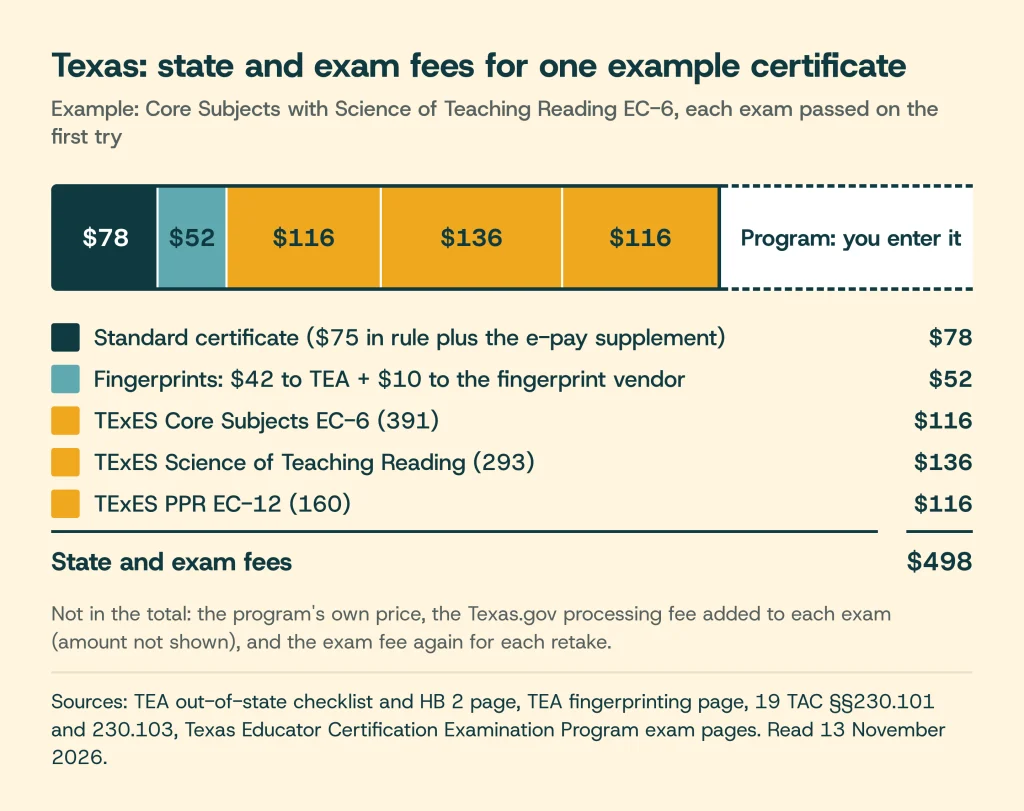
A worked example. Take a candidate seeking the Core Subjects with Science of Teaching Reading EC-6 certificate who passes each exam on the first try. The state and exam fees as read come to $498: standard certificate $78, Core Subjects EC-6 $116, Science of Teaching Reading $136, PPR $116, and fingerprints $42 + $10. The Texas.gov exam processing fees and the program’s own price come on top. The program’s price is set by the program, and we don’t quote one. Each retake adds the exam fee again. Use the teacher certification cost calculator to enter your own exams, attempts and program cost.
Moving here with a license
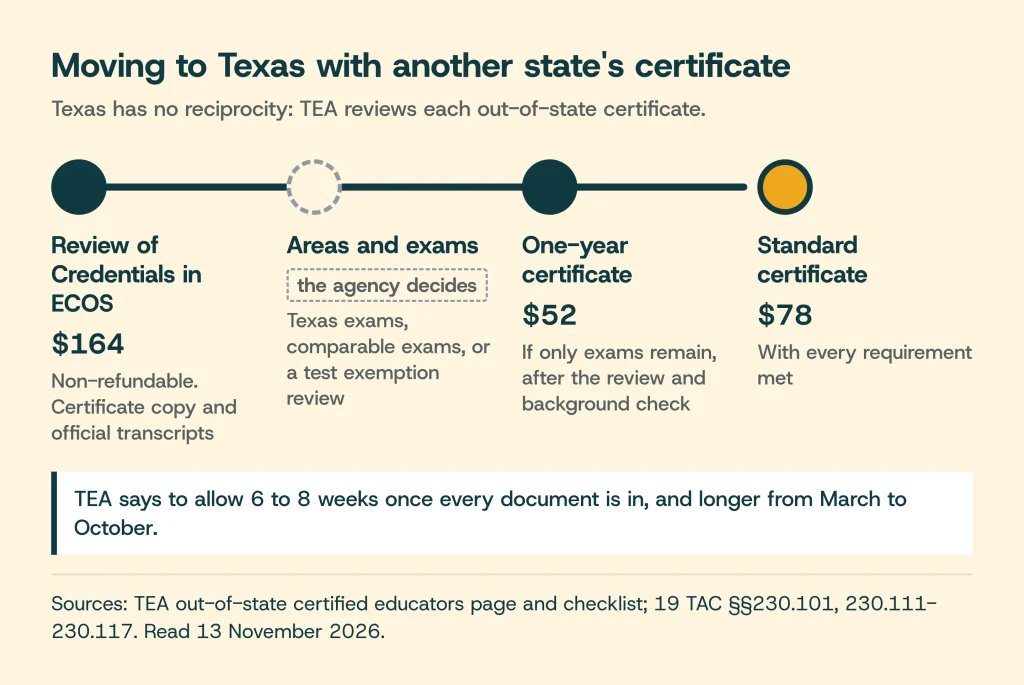
TEA states plainly that Texas “does not have reciprocity” with any other state. A teacher with a standard certificate from another state applies for a Review of Credentials ($164, non-refundable) in ECOS. TEA then decides which Texas areas match and whether Texas exams are still needed. The rules are 19 TAC §§230.111-230.117 (July 2026 update), read 13 November 2026.
- What counts. A degree equal to at least a US bachelor’s, and a certificate from another state’s licensing agency. The certificate may not be expired, a temporary permit, a city or district credential, or one showing program deficiencies (§230.111). TEA’s page adds that, under HB 1178 (2025), the out-of-state certificate must be “valid and active” when the complete application is received.
- What to send. The application and fee, a copy of the certificate uploaded to ECOS, and official transcripts sent electronically to TEA directly by the college. TEA’s checklist says transcripts sent by the applicant are not accepted, and its out-of-state page says not to mail them. Missing documents must arrive within one year or the fee is paid again (§230.117(b)).
- Exams. The applicant passes the Texas exams, shows comparable exams taken in the other state, or is exempted under 19 TAC §152.1001 (§230.113(a)). TEA runs a separate test exemption review and encourages applicants to send score reports and verification of experience with the first application. Its page, read 13 November 2026, lists two options for classroom teachers: exams that the other state required, already passed, plus at least one academic year of full-time, paid classroom teaching; or three or more years of verified experience in the certificate area. The Science of Teaching Reading exam applies to EC-6 and several grade 4-8 areas, has its own exemption criteria, and TEA says classroom experience alone does not exempt anyone from it.
- One-year, then standard. If only exams remain, TEA can issue a one-year certificate ($52) after the review and background check. If the exams aren’t passed in that year, no certificate or permit for the same area follows until they are. The rule lets the employing district ask for an extension of up to one calendar year for circumstances beyond the teacher’s control (§230.113(d)). TEA’s out-of-state checklist (January 2025 edition), read 13 November 2026, says the one-year certificate expires 12 months from its effective date “whether used or not” and cannot be renewed or extended, and suggests applying once a job start date is confirmed. Ask TEA before counting on an extension. With every requirement met, the standard certificate is $78.
- Timing. TEA’s out-of-state page, read 13 November 2026, says to allow 6 to 8 weeks once every required document is in, and that reviews and test exemptions can take longer in its busy season, March to October.
A temporary certificate in the statute. Tex. Educ. Code §21.0521, added by HB 1178 in 2025, tells the SBEC to create a temporary certificate for educators certified in other states and to issue it “immediately” on application. The statute’s conditions are a valid, non-temporary certificate from another state and a bachelor’s degree from an institution accredited then and now. The certificate ends after one year, or when the Texas certificate is issued if that comes first. For a military spouse it lasts three years. It can’t be reissued or renewed, and the board may rescind it if a review of the person’s credentials finds those conditions are not met. TEA’s out-of-state pages, as read on 13 November 2026, describe the Review of Credentials but not how this temporary certificate is requested, so ask TEA’s Educator Certification help desk.
The teacher compact. Texas is not a member of the Interstate Teacher Mobility Compact. The compact had 14 member states as read on 13 November 2026, and Mississippi passed it but is not admitted. Even between member states, the receiving state decides the equivalent license. Military members, veterans and spouses have their own TEA page on certification and fee exemptions under 19 TAC chapter 234. To see what another state asks of a Texas teacher, or the reverse, use the teaching license reciprocity checker.
Renewal and substitutes
Renewal. A standard certificate is renewed every five years in ECOS (19 TAC chapter 232, subchapter A). TEA’s renewal page, read 13 November 2026, requires these continuing professional education (CPE) hours per five-year period:
- 150 CPE hours for a classroom teacher.
- 200 hours for principals, superintendents, counselors, librarians, educational diagnosticians and reading specialists, and 200 in total for someone holding several kinds of certificate.
- Hours must relate to the certificate. All renewing educators need CPE on students with disabilities, including dyslexia.
- One semester credit hour counts as 15 CPE hours. Independent study counts for up to 20% of the hours.
Educators confirm their hours themselves when they renew, and they must keep proof for five years in case of an audit. A certificate not renewed by its expiry date becomes inactive, and while it is inactive its holder may not be employed by a Texas public school district in a position that requires a certificate (19 TAC §232.1(e)). A renewal sent with the hours done before the expiry date counts as on time. An inactive certificate can still be renewed later with the hours and the renewal and late fees, and TEA says the exams don’t have to be taken again. TEA’s renewal page lists hardship exemptions under 19 TAC §232.7 for a catastrophic illness, active-duty military service, or, for an educator employed by a Texas district whose certificate went inactive for missing hours, a request filed by the district. An exemption gives more time for the academic year it is granted in; it does not waive the hours. TEA emails a reminder six months ahead, but the educator stays responsible without it. All of a person’s standard certificates renew together for one fee. More in renewing a teaching certificate.

Substitutes. Texas has no state substitute certificate: the certificate types in 19 TAC §230.31 include none, and TEA’s certification pages list none, as read on 13 November 2026. Each district sets its own substitute requirements, so the district’s human resources office is the source.
What other pages get wrong
You may see these claims on other sites. We checked them against TEA’s own pages and rules on 13 November 2026, and they aren’t what the rules say.
- “An intern certificate lasts one year.” For alternative-program candidates it runs two years from 2026-27 assignments (19 TAC §230.36(c)(3)).
- “Teachers from other states must pass the Texas tests.” TEA can exempt some or all exams after its test exemption review (§230.113(a)(3)).
- “Every candidate takes the PPR.” TEA’s required test chart lists edTPA as an alternative to the PPR in many fields.
- “Texas has reciprocity.” TEA says it has none: it reviews each out-of-state certificate.
Where to apply and check
- TEA’s starting points: Becoming a classroom teacher in Texas and the certification home page. Questions go to TEA’s Educator Certification help desk or (512) 936-8400, option 2.
- Applications: ECOS, reached through a TEAL account. TEA says a Social Security number is needed to create one.
- Exam registration: the Texas Educator Certification Examination Program, after approval from the program (or from TEA’s review, for out-of-state teachers).
- Official lookup: TEA’s certificate lookup. TEA calls the online virtual certificate the official record of certification.
- The rules: 19 TAC Part 7 and Education Code chapter 21.
What to have ready: official transcripts, the program’s recommendation (or, from another state, a copy of your certificate), exam score reports, and a photo ID for the fingerprint appointment. On internship routes you also need a teaching position. To set Texas’s stated minimums beside your own degree and situation, try the teaching route finder. To compare Texas with other states, see the 51-state certification table.
Rules and fees checked on 13 November 2026 against TEA’s certification, testing, fingerprinting, renewal, out-of-state and HB 2 pages, 19 TAC chapters 227, 230 and 232 as posted by TEA, Texas Education Code chapter 21, and the Texas Educator Certification Examination Program’s exam pages. TEA plans its next exam changes for September 2027 at the earliest.
Sources
- TEA: Certification
- TEA: Becoming a classroom teacher in Texas
- TEA: Becoming certified through an alternative certification program
- TEA: Becoming certified through a university program
- TEA: Consumer information about educator preparation programs
- TEA: EPP interactive map
- TEA: ASEP accreditation dashboards
- TEA: Educator testing
- TEA: Educator certification exams
- TEA: Required test chart (May 2024)
- TEA: Fingerprinting process for Texas educator certification
- TEA: Out-of-state certified educators
- TEA: Out-of-state application checklist
- TEA: Out-of-state educator test exemption review
- TEA: Standard certificate renewal and CPE
- TEA: HB 2 educator certification initiatives
- TEA: School district teaching permits
- TEA: Military community and first responders
- TEA: Certificate lookup
- 19 TAC Part 7 (SBEC rules, TEA index)
- 19 TAC chapter 227, subchapter A (admission criteria)
- 19 TAC chapter 230, subchapter C (educator assessment)
- 19 TAC chapter 230, subchapter D (types of certificates)
- 19 TAC chapter 230, subchapter G (fees)
- 19 TAC chapter 230, subchapter H (out-of-state certificates)
- 19 TAC chapter 232, subchapter A (renewal and CPE)
- Texas Education Code chapter 21
- Texas Educator Certification Examination Program: PPR EC-12 (160)
- Texas Educator Certification Examination Program: Science of Teaching Reading (293)
- Texas Educator Certification Examination Program: Core Subjects EC-6 (391)
- Texas Educator Certification Examination Program: edTPA
- Interstate Teacher Mobility Compact