There is no national teaching license. Each state, and the District of Columbia, licenses its own public school teachers through its own agency, with its own routes, tests and fees. The pattern most states share is a bachelor’s degree, a state-approved preparation program with classroom practice, the tests the state names, a background check and an application fee. Almost every part of that pattern has exceptions: routes that let a degree holder teach while training, apprenticeships that start from an associate degree, out-of-state routes, emergency permits, and states that dropped tests other states still require. This page sets out each route a state can list and how the states differ, and it is the starting point of our Becoming a Teacher guides.
This page is general information, not legal or career advice. Each state’s licensing agency decides every application, and rules, tests and fees change, often on 1 July. Confirm the current rules with the agency before you pay for a program, a test or fingerprints.
One more frame before the detail. The license rules here are for public schools. The Bureau of Labor Statistics says public school teachers must hold a state-issued certification or license, while teachers in private schools typically do not need one (BLS Occupational Outlook Handbook, page last modified 27 August 2026, read 13 November 2026). A private school, a charter school or a preschool may follow different rules, set by the state or by the school; our page on what preschool and kindergarten teachers need covers the early grades.
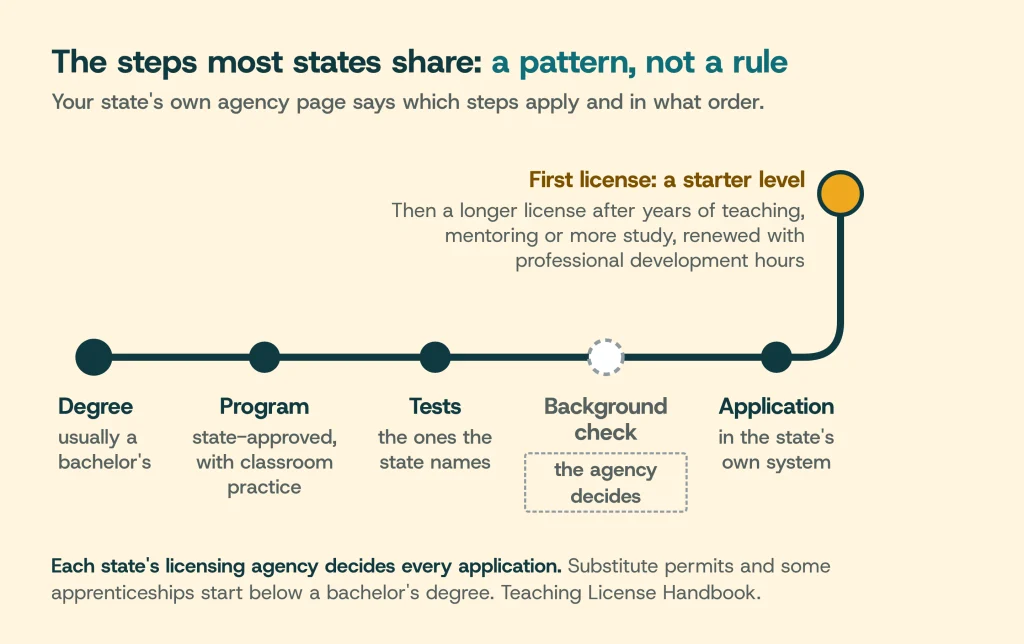
The steps most states share
Read this as a pattern, not a rule. Each step below is something many states ask for; your state’s own agency page says which apply and in what order. Our step-by-step page on how to get a teaching license goes through the application itself.
- A degree. A bachelor’s degree is the usual floor for a full license. Florida, for example, writes it into its eligibility law: a bachelor’s or higher degree and, for initial certification, at least a 2.5 grade point average in the major field, except in the few non-degree areas the State Board lists in rule (Fla. Stat. s. 1012.56(2), read 13 November 2026). Substitute permits and some apprenticeships start lower.
- Preparation. A state-approved educator preparation program (EPP): coursework in teaching methods plus supervised practice in a classroom, often called student teaching. Some routes let a degree holder do this while employed as the teacher of record.
- Tests. Usually a content test in the subject or grade band, and in many states a pedagogy test, a reading-instruction test or a performance assessment. A few states still ask for a basic-skills test; others dropped it.
- Background check. Fingerprints for a state and FBI check. Who pays, and how much, differs by state.
- The application. Filed online in the state’s own system, with transcripts, test scores, the program’s recommendation and the fee.
- The next level. The first license is usually a starter level (initial, provisional, preliminary, resident). A second, longer license follows after years of teaching, mentoring or more study, and is renewed with professional development hours.
The teaching route finder sets the routes a state lists next to the degree, program and experience you enter, and shows what it can’t check. It never tells you which route to take.
Certificate, license or credential
The three words mean the same document: the state’s permission to teach in its public schools. California says credential, most states say certificate or certification, and Illinois, Ohio, North Carolina and others say license. An endorsement is the subject or grade band written on it (elementary, mathematics 7-12, special education). Our page on certificate, license or credential explains each term and the license levels states use.
Every route a state can list
Not every state offers every route, and each state names its routes its own way. These are the six kinds you will meet, with examples read in state law, rules or agency pages. Each example applies only in the state named.
1. The traditional route: a state-approved program
A bachelor’s or master’s degree that includes a state-approved teacher preparation program and student teaching. In many states the program then recommends the candidate to the state; with the state’s tests passed and the application filed, the state decides on the first license. A program approved in one state is not automatically approved in another, and an online program based elsewhere may or may not be approved where you plan to teach. States publish their own lists of approved programs; our page on checking that a program is state-approved shows where each list is. We name no programs and rank none.
2. Alternative and intern routes
For people who already hold a bachelor’s degree outside education. The common shape: meet a GPA and subject-knowledge floor, pass a content test, start a state-approved alternative program, then teach on a temporary or intern license while finishing it. The minimums differ a lot, and several routes need a school’s job offer or sponsorship first. Examples, each as the state’s own text says:
- Texas: to enter an alternative program, a bachelor’s, a 2.50 GPA overall or in the last 60 hours, and 12 semester hours in the subject (15 for some math and science fields) or a passing pre-admission content test (19 TAC 227.10, effective 2 August 2026, read 12 November 2026). From 2026-27, intern certificates for alternative-program candidates run 2 years (19 TAC 230.36).
- New Jersey: the Certificate of Eligibility needs a bachelor’s, a 3.00 GPA (with listed exceptions) and the state’s subject test (N.J.A.C. 6A:9B-8.3, read 12 November 2026).
- New York: the Transitional B certificate needs a bachelor’s with a 3.0 GPA, a subject major or 18 semester hours in it plus 12 related, the required exams and an employment and mentoring commitment; it lasts up to 3 years while enrolled ($50; NYSED, read 12 November 2026).
- Michigan: a bachelor’s and a 3.0 GPA; the Interim Teaching Certificate comes after passing the MTTC while employed (MCL 380.1531i, read 11 November 2026).
- North Carolina: the Residency License needs a bachelor’s, relevant coursework or a content exam, enrolment in a recognised program and a request from the employing public school unit; it lasts 1 year and can be renewed twice (G.S. 115C-270.20, read 11 November 2026).
- Ohio: the Alternative Resident Educator License needs a bachelor’s, a 2.5 GPA, a pedagogical institute and the subject exam (ORC 3319.26, read 11 November 2026).
- Georgia: GaPSC calls GaTAPP the only alternative route to initial certification; it is job-embedded, for bachelor’s holders (GaPSC, read 11 November 2026).
- Illinois: an Educator License with Stipulations for alternative candidates needs a bachelor’s, the first phase of an alternative program and a passed content test; it lasts 2 years and can be renewed for a third (105 ILCS 5/21B-20, read 12 November 2026).
More on these routes, state by state, is on our alternative teacher certification page; if you hold a degree in another field, the page on teaching without an education degree starts from there.
3. Residencies and apprenticeships
A residency puts a candidate in a classroom beside a mentor teacher for a long stretch before taking a class alone. Texas now lists a teacher residency route with a full school year of preservice practice, beside its traditional and alternative routes (Tex. Educ. Code 21.04421 to 21.04423, as amended by HB 2 of 2025, read 12 November 2026). New York’s Residency certificate is for people enrolled in a registered residency program; the holder cannot be the teacher of record (NYSED, read 12 November 2026).
An apprenticeship is paid on-the-job training under a registered apprenticeship. Florida’s Teacher Apprenticeship Program starts from an associate degree with a 2.5 GPA, a background screening and a temporary apprenticeship certificate; the apprentice is employed as a paraprofessional, spends at least the first 2 years in a mentor teacher’s classroom, and still needs the bachelor’s degree the state requires before applying for a Professional Certificate (Fla. Stat. s. 1012.555, read 13 November 2026). Kansas and Oregon also list an apprenticeship route among their pathways (agency pages, read 11-13 November 2026). Our page on moving from paraprofessional to teacher covers these routes.
4. The out-of-state route
For teachers licensed in another state. There is no national reciprocity: the receiving state reviews your license and decides which of its own licenses to issue, and whether you still owe its tests or coursework. A few examples show how far apart the rules are. New York endorses a comparable out-of-state certificate with 3 years of certified teaching rated effective, without New York exams, at the Initial level (NYSED, read 12 November 2026). Oklahoma accepts a standard or professional license without extra tests, but not a provisional, emergency or temporary one (OSDE, read 12 November 2026). Michigan waives the MTTC with 3 years of successful teaching under the out-of-state certificate (MDE, read 11 November 2026). Texas runs a $164 review of credentials (including the online payment fee) and must issue a temporary certificate on application to holders of a valid, non-temporary out-of-state certificate and an accredited bachelor’s; it lasts up to 1 year (3 for military spouses), or until the Texas certificate is issued, and cannot be renewed (Tex. Educ. Code 21.0521, read 12 November 2026). The section on the compact below covers the newer interstate route.

5. Emergency, provisional and temporary licenses
Short licenses a state issues, usually at a district’s request, so someone can teach while finishing the full requirements. They are time-limited, and many cannot be renewed. Examples: North Carolina’s Emergency License lasts 1 year (G.S. 115C-270.20, read 11 November 2026); Texas lists an emergency permit at $55 in rule (19 TAC 230.101, read 12 November 2026); Pennsylvania’s emergency permit is $100 (PDE, read 12 November 2026); in Oklahoma, emergency certificates are requested by the district and approved by the State Board (OSDE, read 12 November 2026). Under the interstate compact’s model legislation, provisional, temporary and substitute licenses are not “unencumbered”, so they don’t open the compact route. Our page on emergency and provisional certificates has the state detail.
6. Substitute permits
The lowest bar, and the widest spread. Florida’s statutory minimum is a high school diploma or equivalent, with fingerprints and training (Fla. Stat. s. 1012.35, read 11 November 2026). Michigan’s Daily Substitute Permit needs 60 semester hours or an associate degree ($45; MDE, read 12 November 2026). California’s 30-day substitute permit needs a bachelor’s degree ($100; CTC CL-505p, read 12 November 2026). Illinois’s short-term substitute license needs an associate degree or 60 credit hours ($25) and ends on 30 June 2028 (105 ILCS 5/21B-20, read 12 November 2026). Texas has no state substitute certificate; districts decide (TEA, read 12 November 2026). Day limits often apply: in New York, an uncertified substitute not working toward certification may work 40 days a year in a district, more in the cases the rule lists (NYSED, read 12 November 2026). Our substitute teacher requirements page covers all 51.
The tests
There is no national teacher test. Each state chooses its own tests and passing scores, and many use their own state-branded tests. Many states use ETS’s Praxis tests; others use Pearson state programs such as TExES (Texas), CSET and CBEST (California), NYSTCE (New York), ILTS (Illinois), MTTC (Michigan), OAE (Ohio) and GACE (Georgia). A state’s tests usually fall into five kinds:
- Content tests in the subject or grade band. All 14 states in the table below name them; California also accepts approved coursework or a degree in the subject instead of the CSET.
- Pedagogy tests on teaching practice: Texas’s Pedagogy and Professional Responsibilities (PPR), New York’s Educating All Students, Ohio’s and Oklahoma’s Assessment of Professional Knowledge, Florida’s Professional Education test.
- Reading-instruction tests for early childhood, elementary and special education: Foundations of Reading in Oklahoma, North Carolina and Ohio, Texas’s Science of Teaching Reading, and from 1 September 2026 South Carolina’s reading test (state sources read 12-13 November 2026).
- Performance assessments, a portfolio of real teaching: North Carolina asks for edTPA or PPAT; California for CalTPA, edTPA or FAST; Illinois paused edTPA, not dropped it: a state pilot runs from 1 September 2026 to 31 August 2029 and the requirement returns on 1 September 2029 (105 ILCS 5/21B-30; state sources read 12 November 2026). Our edTPA page lists where it is required.
- Basic-skills tests in reading, writing and math. Fewer states use them now. Nevada still requires Praxis Core, with exemptions for a master’s within 10 years, an SAT of 1100 or an ACT of 21; North Dakota requires a Core composite of 466 (agency pages, read 13 November 2026). In California a bachelor’s degree meets the basic-skills requirement (Ed. Code 44252(b)(12), read 12 November 2026). Our Praxis Core page lists who still asks for it.
What Praxis costs, 2026-27 testing year (1 August 2026 to 31 July 2027; ETS Praxis Information Bulletin 2026-27, read 13 November 2026): Core $90 a test, or $150 for the three together as Core Combined (5752); subject tests $130 selected-response and $156 constructed-response or mixed; World Language $170; Elementary Education: Content Knowledge for Teaching (7811) $209. A non-refundable 3% online service fee is added to every online transaction. Cancel at least three days before the test and half the test fee is refunded. ETS says its fees are subject to change without notice, and the bulletin covers only the testing year to 31 July 2027; Nevada test centres add $5 to each Subject Assessment.
Our page on which tests each state requires has the list for all 51, and Praxis fees and passing scores covers retakes and score reviews.
How states differ: 14 states
The agency, the main tests, the fee for the first standard certificate and the background-check charge, for the 14 states with their own page here. Each row is as read on the agency’s pages, rules or statutes on 11 or 12 November 2026; test fees are on each state’s page. A background-check line says “+ site fee” where the fingerprinting site adds its own charge, which varies. The state pages have the routes, levels, renewal and every source.
| State | Agency | Main tests | Certificate fee | Background check |
|---|---|---|---|---|
| California | CTC | CSET or coursework; TPA | $100 + $2.65 online | $32 DOJ + $17 FBI + site fee |
| Texas | TEA | TExES content, PPR, STR | $78 standard | $42 + $10 |
| Florida | FLDOE | FTCE GK, PEd, subject | $75 per subject | set locally |
| New York | NYSED | EAS + content (CST) | $50 per title | $107.50 |
| New Jersey | NJDOE | Praxis content | $170 CE or CEAS | $10 + $1 + $68.98 |
| Illinois | ISBE | ILTS content | $100 ($150 if not IL-prepared) | not charged to applicant |
| Washington | OSPI | WEST-B taken; NES content | $93 Residency | $50 + site fee |
| Pennsylvania | PDE | PECT or Praxis | $50 + $100 | $62.95 (3 clearances) |
| Oklahoma | OSDE | OSAT, APK, FoR | $50 | $58.25 |
| Colorado | CDE | Praxis content | $90 | $39.50 + site fee |
| North Carolina | DPI | content, FoR, edTPA or PPAT | $70 | no applicant fee |
| Georgia | GaPSC | GACE content, Ethics, literacy | at most $20 | $42 state fee |
| Michigan | MDE | MTTC | $160 | not confirmed |
| Ohio | SBOE | OAE APK, content, FoR | $80 | $22 + $27 + site fee |
Sources for the table: CTC (CL-659, updated 20 October 2026); TEA and 19 TAC 230.101; FLDOE and Rule 6A-4.0012; NYSED; N.J.A.C. 6A:9B-5.6 and NJDOE; 105 ILCS 5/21B-40 and 10-21.9 and ISBE; OSPI; PDE (Act 47 of 2025); OSDE; CDE and the Colorado Bureau of Investigation; 16 NCAC 06C .0371, G.S. 115C-332 and DPI; GaPSC and the GBI fee list; MDE; SBOE and the Ohio Attorney General. State fees often change on 1 July and fingerprint vendor fees on 1 October.
The other 37 rows are on our teacher certification by state table, with “not confirmed” wherever a field could not be read in official text. Four state agencies’ certification pages (Arizona, Mississippi, Tennessee and Virginia) were not confirmed in official text as of 13 November 2026, and Louisiana’s certificate fee amounts were not found in its published pages (read 12 November 2026); the table links each agency instead. The cost calculator adds up a state’s application, test and fingerprint fees with their sources and leaves program tuition for you to enter. It gives an estimate, not a quote.
Moving states and the compact
The Interstate Teacher Mobility Compact is an agreement between member states to grant an equivalent license to a teacher who holds an eligible, unencumbered license from another member state. As read on 13 November 2026, the compact’s map lists 14 member states: Alabama, Colorado, Delaware, Florida, Kansas, Kentucky, Nebraska, Nevada, Oklahoma, Oregon, Pennsylvania, Utah, Virginia and Washington. Mississippi passed it with material language changes and is marked “not admitted” (teachercompact.org and its map data, read 13 November 2026).
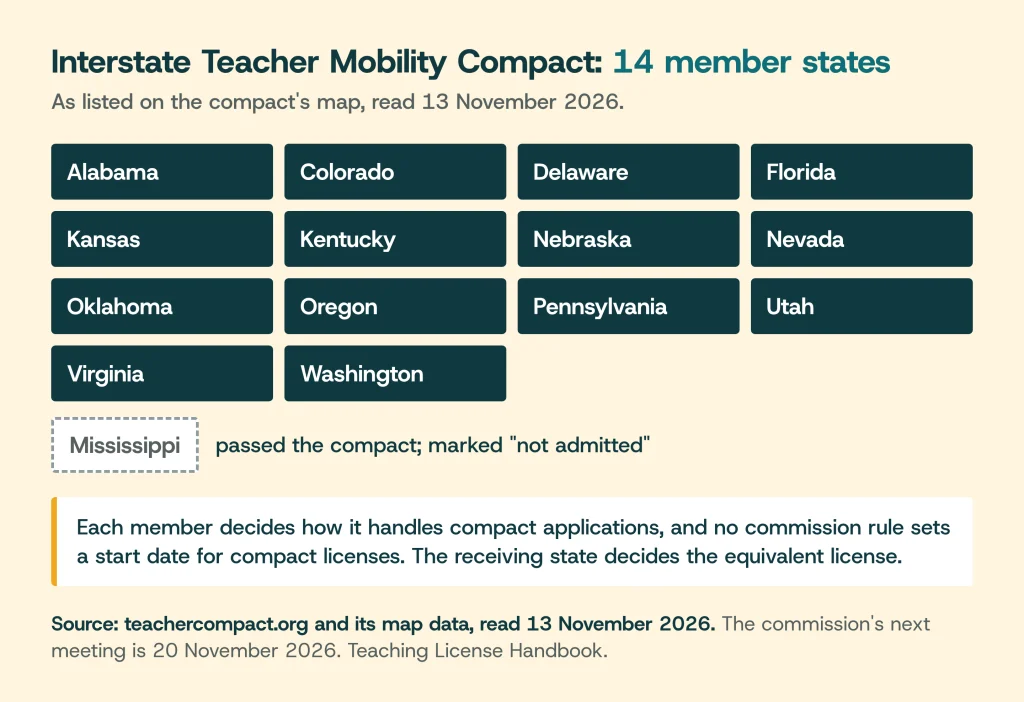
What the compact’s model legislation says, in short (read 11 November 2026): the license must rest on at least a bachelor’s degree and a state-approved program; “unencumbered” excludes restricted, probationary, provisional, substitute and temporary licenses; the receiving state decides which of its licenses is equivalent; military members and spouses get an equivalent license even without an unencumbered one; and it covers the first grant only, after which the new state’s renewal rules apply.
Each member decides how it handles compact applications, and no commission rule sets a start date for compact licenses. As read on 12 and 13 November 2026: Pennsylvania reviews applications under the compact as its Pathway 3, with a testing exception; Nebraska publishes steps for compact-state teachers; Utah says it will grant an equivalent Utah license to holders of a standard renewable professional license from another member state through its License Equivalency Review; Colorado issues an initial license within 30 days to holders of an unencumbered equivalent license from a compact state until it starts issuing compact licenses (SB26-126). Washington’s and Oklahoma’s pages showed no compact route when read on 12 November 2026. The commission’s next meeting is 20 November 2026, and this section is rechecked after it. The reciprocity and compact checker shows a destination state’s out-of-state rule and the compact’s status as read; the receiving state decides the equivalent license.
License levels and renewal
The first license is rarely the last. Most states move teachers from a starter license to a longer one, and each sets its own conditions:
- California: a Preliminary credential for up to 5 years, then a Clear credential after an induction program or another clear option, renewed every 5 years ($125 plus $2.65 online since 1 July 2026; CTC CL-561 and CL-659, read 12 November 2026).
- North Carolina: an Initial Professional License for 3 years, not renewable, then a Continuing Professional License for 5 years, renewed with 8 CEUs (G.S. 115C-270.20 and DPI, read 11 November 2026).
- Ohio: a 2-year Resident Educator License, then a 5-year Professional license, renewed with 6 semester hours or 18 CEUs (SBOE, read 11-12 November 2026).
- Pennsylvania: Instructional I, valid for 6 service years, then the permanent Instructional II after 3 years of satisfactory Pennsylvania service and 24 post-bachelor’s credits; 180 hours or 6 credits every 5 years keep it active (PDE, read 12 November 2026).
- New York: an Initial certificate for 5 years, then Professional after 3 years of teaching and a related master’s degree; 100 CTLE hours per 5-year registration (NYSED, read 12 November 2026).
- Texas: a 5-year Standard certificate renewed with 150 CPE hours for classroom teachers (TEA, read 12 November 2026).
- Colorado: an Initial license for 3 years, then Professional for 7, renewed with 90 contact hours (CDE, read 12 November 2026).
Our renewal page has the hours and cycles by state.
How long it takes
There is no single answer, because the clock depends on the route, the program and how soon the tests are passed. The rules do set some outer limits. Texas intern certificates for alternative-program candidates run 2 years from 2026-27, with no more than three 12-month periods on intern or probationary certificates or permits (19 TAC 230.36, read 12 November 2026). North Carolina’s Residency License lasts 1 year and can be renewed twice (G.S. 115C-270.20). Illinois’s alternative license lasts 2 years and can be renewed for a third (105 ILCS 5/21B-20). Florida’s apprentices spend at least 2 years in the apprenticeship before applying for a Professional Certificate (s. 1012.555). Our page on how long it takes to become a teacher goes route by route.
Pay and loan help
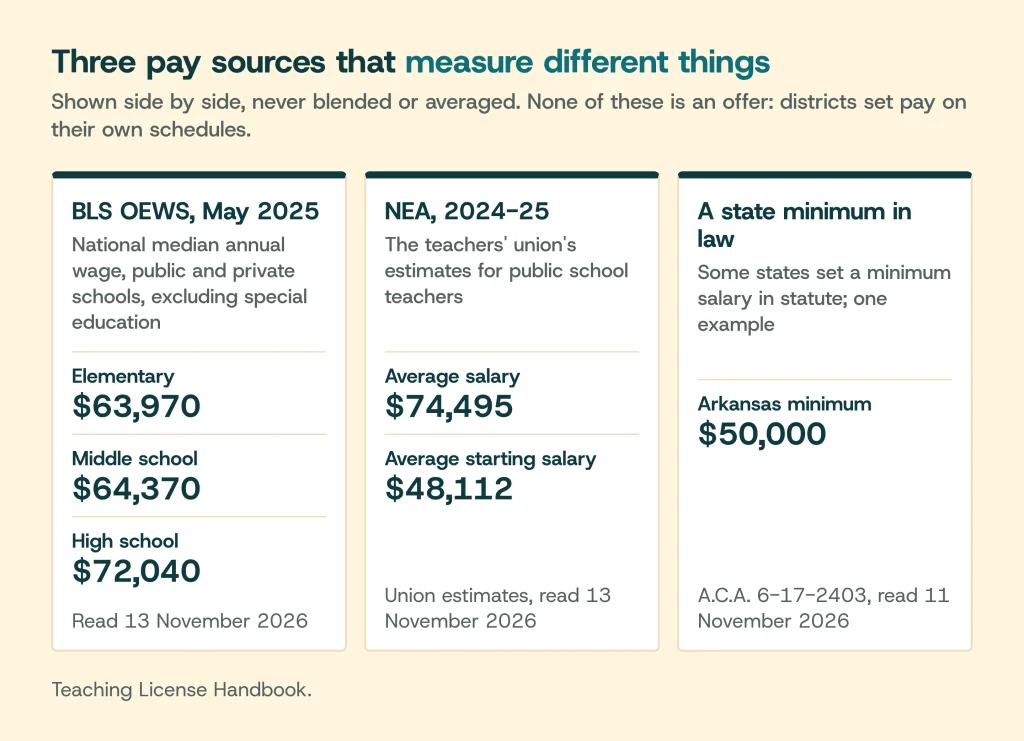
Three sources measure teacher pay, and they measure different things, so we never blend them. BLS OEWS, May 2025, gives national median annual wages, across public and private schools, of $63,970 for elementary, $64,370 for middle school and $72,040 for high school teachers, each excluding special education (read 13 November 2026). NEA, the teachers’ union, estimates the 2024-25 average public school teacher salary at $74,495 and the average starting salary at $48,112 (union estimates, read 13 November 2026). Some states also set a minimum salary in law, such as Arkansas’s $50,000 (A.C.A. 6-17-2403, read 11 November 2026). None of these is an offer: districts set pay on their own schedules. The teacher salary by state page shows all three, labelled.
Three federal student aid programs matter most to teachers (studentaid.gov and the eCFR, read 11-13 November 2026). The TEACH Grant pays up to $4,000 a year to students preparing to teach in a high-need field; after the federal sequester reduction it is $3,772 for awards first paid from 1 October 2026 to 30 September 2027 (FSA electronic announcement GENERAL-26-28, read 12 November 2026). The service obligation is 4 years of full-time teaching in a high-need field at a low-income school within 8 years, or the grant becomes a Direct Unsubsidized Loan. Teacher Loan Forgiveness forgives up to $5,000, or up to $17,500 for qualifying math, science and special education teachers, after 5 complete, consecutive years at a low-income school (34 CFR 685.217). Public Service Loan Forgiveness needs 120 qualifying monthly payments (34 CFR 685.219), and the years used for Teacher Loan Forgiveness can’t also count toward it. The Teacher Loan Forgiveness or PSLF tool sets the two side by side on your own numbers; your servicer and the Department of Education decide.
Claims you may see elsewhere
Many pages that rank for this question are out of date. These are the claims we checked against the states’ own text:
- “Every state requires the Praxis.” It isn’t what the states’ own pages say. Texas, California, New York, Illinois, Michigan, Ohio and Georgia use their own state test programs, run by Pearson, and Florida uses the FTCE (state sources, read 11-12 November 2026).
- “You must pass the Praxis Core first.” Pennsylvania no longer lists basic skills as a certification requirement (PDE, read 12 November 2026), New Jersey keeps Core only for limited certificate of eligibility cases (P.L.2024, c.26; NJDOE, read 12 November 2026), and in California a bachelor’s degree meets the requirement. Nevada and North Dakota still ask for Core (agency pages, read 13 November 2026).
- “edTPA is required.” New York ended it on 27 April 2022, and Washington and Georgia no longer require it (state sources, read 12 November 2026). Illinois paused it rather than dropping it; see the tests section above.
- “California requires RICA.” RICA was last offered on 31 October 2025 (the CTC’s official testing site, read 12 November 2026).
- “Pennsylvania charges $200.” Since 12 November 2025 the fee is $50 plus a $100 discipline fee under Act 47 of 2025 (PDE, read 12 November 2026).
- “The compact lets you teach in any member state now.” It covers member states only, for an unencumbered license, and each member decides how it handles applications; see the compact section above.
Where to start
Start with the state where you plan to teach, not with a program or a test.
- Open the state agency’s certification page (linked under the table above and on our certification by state hub) and read its list of routes for your subject and grade band.
- Check any program against the state’s own approved list before you enrol or pay a deposit.
- Look up the tests the state names for your area on the vendor’s own registration site (ETS for Praxis, the state’s Pearson site otherwise), with the current fee and the passing score the state sets.
- Have these ready: official transcripts from every college attended, test score reports, a fingerprint appointment where the state uses a named vendor (in some states the district arranges the check), and, for routes that need one, a school or district’s offer or sponsorship letter.
- Apply in the state’s own system (for example TEACH in New York, ELIS in Illinois or NJEdCert in New Jersey), and use the state’s official certificate lookup afterwards to confirm what was issued.
Changing careers? Our page on changing careers into teaching walks through the same steps from a working adult’s side. Planning to teach special education? See special education certification.
Rules and fees checked on 13 November 2026. The Praxis fees, the compact’s members and commission page, Florida’s statutes, the BLS Occupational Outlook Handbook and OEWS tables, NEA’s figures and the eCFR loan rules were read on 13 November 2026; state rows were read in each agency’s pages, rules or statutes on 11 or 12 November 2026, as dated at each claim. State fees often change on 1 July, the Praxis testing year on 1 August, OEWS each spring and NEA’s estimates each April; the compact is rechecked after its 20 November 2026 meeting. By Teaching License Handbook.
Sources
- ETS, Praxis Information Bulletin 2026-27
- BLS Occupational Outlook Handbook: Kindergarten and Elementary School Teachers, How to Become One
- Interstate Teacher Mobility Compact (teachercompact.org)
- Interstate Teacher Mobility Compact commission meetings
- Florida Statutes s. 1012.56, educator certification
- Florida Statutes s. 1012.555, Teacher Apprenticeship Program
- California Commission on Teacher Credentialing: teaching credential requirements
- Texas Education Agency: certification
- Florida Department of Education: educator certification
- NYSED Office of Teaching Initiatives
- New Jersey Department of Education: certification
- N.J.A.C. 6A:9B (NJDOE)
- Illinois State Board of Education: educator licensure
- Washington OSPI: certification
- Pennsylvania Department of Education: certification
- Oklahoma State Department of Education: teacher certification
- Colorado Department of Education: educator licensing
- North Carolina DPI: educator licensure
- Georgia Professional Standards Commission: certification
- Michigan Department of Education: educator certification
- Ohio State Board of Education: educator licensure
- 34 CFR 685.217, Teacher Loan Forgiveness (eCFR)
- 34 CFR 685.219, Public Service Loan Forgiveness (eCFR)
- studentaid.gov: TEACH Grant
- BLS Occupational Employment and Wage Statistics, May 2025
- NEA, Educator Pay and Student Spending (teachers' union estimates)