In California, a teaching license is called a credential, and the Commission on Teacher Credentialing (CTC) issues it. The usual route is a bachelor’s degree, a Commission-approved preparation program, a subject-matter test or approved coursework, and a teaching performance assessment. That leads to a five-year Preliminary credential, which is then cleared through a two-year induction program. The CTC charges $100 per application plus a $2.65 online service fee (CTC leaflet CL-659, updated 20 October 2026, read 13 November 2026). Since 29 June 2024 a bachelor’s degree meets the basic skills requirement, so most applicants no longer need the CBEST. This page sets out each part with the rule behind it. It sits in our certification by state guides.
This page is general information, not legal or career advice. Each state’s licensing agency decides every application, and rules, tests and fees change, often on 1 July. Confirm the current rules with the agency before you pay for a program, a test or fingerprints.
Rules as read on 13 November 2026, from the CTC’s teaching credential requirements page and the leaflets it links. Each figure below names its source and when it was read.
Credential levels
California has a two-tier system, and the CTC uses “certification”, “license” and “credential” in different senses. A credential authorizes teaching. A permit authorizes narrower or short-term service. A certificate can mean a document that authorizes no teaching at all, such as the Certificate of Clearance below.
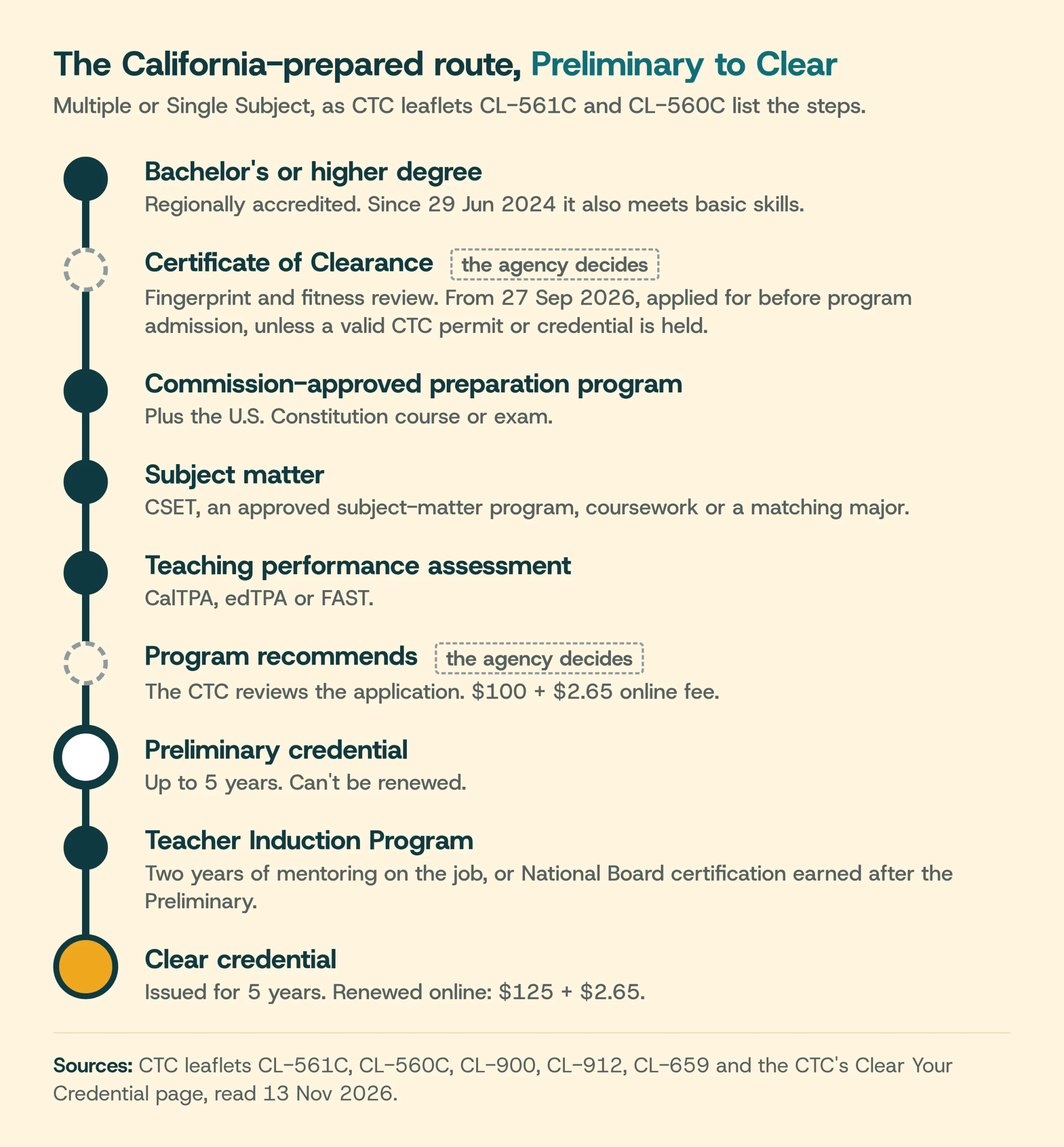
- Preliminary credential. The first full credential, issued for at most five years. It can’t be renewed. It has to be upgraded to Clear, and if that isn’t done before it expires, the holder can’t teach in California public schools on it until the requirements are met (CL-561C and CTC’s “Clear Your Credential” page, read 13 November 2026).
- Clear credential. Issued once all requirements are met. It is issued for five years (CL-912) and renewed online (CTC renewal page and “Clear Your Credential” page, read 13 November 2026).
- Intern credentials. These let someone teach while finishing a preparation program. University and district intern credentials for Multiple and Single Subject are valid for two years. The Education Specialist district intern credential is valid for three (CL-402A and CL-707B, read 13 November 2026).
- Certificate of Clearance (COC). Proof that the holder has passed the CTC’s fingerprint and professional fitness review. It authorizes no teaching. It is valid for five years (CL-900, updated 14 October 2026), and the CTC renewal page says it can’t be renewed: a new one is applied for instead (both read 13 November 2026).
The main teaching credentials are the Multiple Subject (a self-contained classroom, as in most elementary schools), the Single Subject (one subject, as in most middle and high schools), the Education Specialist Instruction credential (special education) and the PK-3 Early Childhood Education Specialist credential. Each has its own leaflet. Life credentials stopped being issued on 1 September 1985, but those already issued remain valid (CTC renewal page).
Routes the CTC lists
The CTC’s requirements page lists these routes to a Multiple or Single Subject credential: California prepared, District Intern, Early Completion Intern Option, Out of State Prepared, Outside the United States Prepared, Peace Corps Experience, Private School Experience and University Intern (read 13 November 2026). Here is what each involves, from its leaflet.
California-prepared (the traditional route)
Leaflet CL-561C (Multiple Subject, last updated 1 October 2026) lists every requirement for the Preliminary credential:
- a bachelor’s or higher degree from a regionally accredited college or university
- subject-matter competence, shown in one of several ways (see Tests below)
- a course of two semester units or three quarter units on the U.S. Constitution, or a college exam on it
- a Commission-approved preparation program. The program covers reading instruction, computer technology and health education, and requires CPR training covering infants, children and adults
- a passed teaching performance assessment (TPA)
- a formal recommendation from the program
The Single Subject leaflet (CL-560C) follows the same pattern. New since 27 September 2026: before admission to a Commission-approved Multiple Subject, Single Subject, Education Specialist or PK-3 program, a candidate must either hold a valid CTC permit or credential or have applied for a Certificate of Clearance (CL-561C, CL-900). The Certificate of Clearance is also needed before student teaching (CL-900).
Preparation programs are run by colleges, universities, school districts and county offices of education. The CTC lists every approved one on its approved institutions and programs dashboard, an interactive list of programs currently offered (read 13 November 2026). We don’t name, rank or compare programs. For how to check a program’s standing, see checking that a preparation program is state-approved.
Intern routes: teaching while you train
California’s alternative routes are intern credentials. An intern is the teacher of record while finishing a program. For how these compare with other states, see alternative teacher certification.
- University Intern (CL-402A, updated 1 October 2026): requires at least 120 hours of intern preservice preparation and enrolment in a Commission-approved intern program. These programs last one to two years and are run by California colleges and universities with local employers. Other requirements: a bachelor’s degree, subject-matter competence and the U.S. Constitution requirement. The credential authorizes service under the supervision of the university and the holder’s employer, and employment is limited to one school agency.
- District Intern (CL-707B, updated 1 October 2026): requires the employing district’s governing board to sign a statement (form CL-707A) that a certificated employee will guide the intern. The district must also have a Professional Development Plan on file. Before daily teaching starts, the intern completes 120 clock hours of training or six semester units. Degree, subject-matter and Constitution requirements are as above.
- Early Completion Intern Option (CL-840, updated 1 October 2026): lets an intern skip program coursework. It requires an offer of employment and enrolment in an approved intern program, a passing score on the NES Assessment of Professional Knowledge (APK, code 051 elementary or 052 secondary), and a pass on the whole TPA at the first attempt within the program’s first year. A candidate who misses any part of that first attempt must complete the full program. The APK fee is not confirmed in official text; the CTC exams site sends APK registration to the National Evaluation Series site.
Interns who finish are recommended for the five-year Preliminary credential and then complete induction to clear it (CL-402A, CL-707B).
Other routes
Teachers with three or more years in a regionally accredited private school have their own leaflet (CL-834), as do Peace Corps teachers (CL-535) and teachers prepared outside the United States (CL-871). Their requirements are not covered on this page. Read them on the CTC requirements page. Teachers prepared in another US state are covered under “Moving to California” below.
Tests and what replaces them
California’s requirements fall into four areas: basic skills, subject matter, a performance assessment and, for some credentials, literacy. Several can be met without a test. Our CBEST and CSET guide covers both tests in detail.
Basic skills: a degree now meets it
Education Code section 44252(b)(12) exempts from the basic skills test “an applicant who has obtained a baccalaureate degree or higher degree from a regionally accredited institution of higher education”. It was added by SB 153 (Stats. 2024, ch. 38) and took effect on 29 June 2024 (official text read on leginfo.legislature.ca.gov, 13 November 2026). CTC’s leaflet CL-667 (updated 1 October 2026) applies this: most applicants meet the requirement through their degree. The exceptions are a few documents that don’t require a bachelor’s degree, including the substitute permit for prospective teachers. CL-667 also says intern candidates must meet the requirement before serving as an intern, that a college or university may ask for it before program enrollment, and that a district may ask for it as a condition of employment, so check with the program and the district before paying for a test.
For those who still need it, CL-667 lists other ways to meet the requirement:
- qualifying college coursework in reading, writing and math (B or better, at least 3 semester units each)
- a mix of coursework and exams
- qualifying SAT, ACT or AP scores, or passing CSU placement results
- CSET Multiple Subjects plus CSET Writing Skills
- another state’s basic skills exam
- the CBEST: a scaled 41 on each of reading, writing and math, or as low as 37 on one section if the total is at least 123. Sections can be retaken, with the full fee each time
The CBEST costs $30 a section, and each section is registered and paid for separately (CTC exams site run by Pearson, read 13 November 2026).
Subject matter: CSET or coursework
Subject-matter competence can be shown in any of these ways (CL-561C, CL-560C):
- passing the CSET (California Subject Examinations for Teachers)
- completing a Commission-approved subject-matter program
- coursework verified by an approved preparation program
- a degree major that matches the credential. For Multiple Subject, that means liberal studies or an interdisciplinary major covering the required content areas
- a mix of these, for candidates enrolled in an approved program
For the PK-3 credential, a degree in child development or one of the listed related fields counts, as do 24 semester units in early childhood education or child development (CL-707B, CL-402A).
CSET Multiple Subjects has three subtests, and the passing score is 220 on each (CL-674M, read 13 November 2026). Passing scores must be used for a credential within ten years, and each subtest’s ten years runs separately (CL-674M). The fee is $99 a subtest taken separately or $247 for all three taken together at a test center. Online-proctored subtests are $99 each and are registered separately (CTC exams site, read 13 November 2026). Single Subject CSET fees vary by test and are listed on each test’s page on the CTC exams site.
Teaching performance assessment
Preparation program candidates must pass a Commission-approved TPA. A performance assessment grades recorded lessons and written commentary from real teaching. The approved models are the CalTPA, edTPA and FAST (as read 12 November 2026). The CTC exams site says CalTPA candidates take and pass two cycles (read 13 November 2026). The fees are:
- CalTPA: two instructional cycles at $150 each, so $300 for both (CTC exams site, read 13 November 2026). The vendor’s page says the 2025-26 versions added math and literacy cycles for Multiple Subject, PK-3 and some Education Specialist areas.
- edTPA: $300, with retake prices of $300, $200 or $100 depending on how many tasks are retaken (edTPA’s candidate policies page, read 13 November 2026). See which states use edTPA.
- FAST: fee not confirmed.
Literacy: RICA has been retired
The Reading Instruction Competence Assessment (RICA) has been retired. CTC’s intern, Early Completion and PK-3 leaflets now list RICA only for results “prior to October 31, 2025” (CL-402A, CL-707B, CL-840, CL-912, read 13 November 2026). Program Sponsor Alert 24-10 had given the retirement date as 30 June 2025, under SB 488 (Stats. 2021, ch. 678).
Multiple Subject, Education Specialist and PK-3 candidates now meet the literacy requirement in one of two ways:
- A Commission-approved literacy performance assessment. Program candidates take this inside their program.
- The Foundations of Reading exam. Program Sponsor Alert 24-10 (revised 24 September 2026, read 13 November 2026) opens this only to listed groups:
- Preliminary holders with a RICA renewal code
- candidates who finished everything except RICA by 30 June 2025
- Single Subject holders adding a Multiple Subject, listed Education Specialist or PK-3 credential
- private-school teachers seeking a Multiple Subject or PK-3 credential
- teachers prepared in another country or through the Peace Corps
The CTC exams site says Foundations of Reading is registered only through the National Evaluation Series site (read 13 November 2026). Its California fee and passing score are not confirmed in official text.
Claims you may still see
- “Everyone must pass the CBEST.” Since 29 June 2024, a bachelor’s or higher degree from a regionally accredited institution meets the basic skills requirement (Ed. Code 44252(b)(12)).
- “California requires RICA.” RICA was retired. CTC’s leaflets accept it only for results before 31 October 2025.
- “California tests are free.” The state fee waiver program ended on 30 June 2024. Candidates who registered by that date had one year from registration to test free (the program’s own FAQ on the CTC exams site, read 13 November 2026). The exams site’s list of tests still showed the old “free while funds remain” wording on 13 November 2026; the FAQ is the newer statement.
For other states’ tests, see teacher certification tests by state.
Fees and fingerprints
The CTC is fee-supported, and its fees can’t be refunded (CL-659, citing Education Code 44235 and Title 5, CCR 80487). Its fee schedule (CL-659, last updated 20 October 2026, read 13 November 2026) sets these amounts:
| Fee | Amount | Source, date read |
|---|---|---|
| Any initial credential, permit or added authorization | $100 | CL-659, 13 Nov 2026 |
| Online service fee, each transaction | $2.65 | CL-659, 13 Nov 2026 |
| Clear credential renewal | $125 (since 1 Jul 2026) | CL-659, 13 Nov 2026 |
| Certificate of Clearance | $50 | CL-659, CL-900, 13 Nov 2026 |
| Fingerprint cards, applicants living outside California | $49 to the CTC | CL-659, 13 Nov 2026 |
| Live Scan, California residents | Paid to the Live Scan operator | CL-659, 13 Nov 2026 |
Every applicant needs fingerprint clearance from the California Department of Justice (DOJ) and the FBI through the CTC (Education Code 44340 and 44341, as the CTC’s fees and fingerprinting page states them, read 13 November 2026). Clearance done for another agency, an employer or another state doesn’t count. The same page says a valid U.S. Social Security Number or Individual Taxpayer Identification Number (ITIN) is needed to obtain a California teaching credential. The two methods are:
- California residents: Live Scan. Use the CTC’s form 41-LS and pay at the Live Scan site. The DOJ’s applicant fee schedule lists $32 (state) plus $17 (FBI) for a general certificate or license. That schedule is headed “As of August 17, 2012 – Subject to Change”, and the DOJ’s Live Scan locations page links it as its list of current fee charges (both read 13 November 2026). Each Live Scan site adds its own rolling fee, which varies. The CTC gives a DOJ processing time of 3 to 7 days for Live Scan.
- Applicants living outside California: fingerprint cards. Order FD-258 cards from the CTC and send them with the $49 fee and the “Stamp Number” from your online application. The CTC gives 10 to 12 weeks for cards. Non-residents who can travel to California may use Live Scan instead (CTC fees and fingerprinting page).
Certificate of Clearance credit. Online, the COC costs $52.65 ($50 plus the $2.65 service fee). CL-900 says the $50 then becomes a credit toward the first teaching or services credential when the program sponsor’s online recommendation is paid.
Military spouses. The $100 fee for an initial Multiple Subject, Single Subject, Education Specialist Instruction or Designated Subjects credential is waived for an out-of-state-prepared applicant who moves to California because of military orders that require the applicant’s spouse to relocate. The waiver covers only the first California credential, and it isn’t available for renewals or through the online application. Fingerprinting and its fee still apply (CL-659).
Fees added up: one example
This example is a Multiple Subject candidate who finishes a California program, takes all three CSET subtests together and the two CalTPA cycles, and uses Live Scan. State and test fees, as read on the dates above:
| Line | Amount |
|---|---|
| Preliminary credential application | $100.00 |
| CTC online service fee | $2.65 |
| CSET Multiple Subjects, three subtests together | $247.00 |
| CalTPA, two cycles | $300.00 |
| DOJ $32 + FBI $17 (2012 schedule) | $49.00 |
| Total of state and test fees | $698.65 |
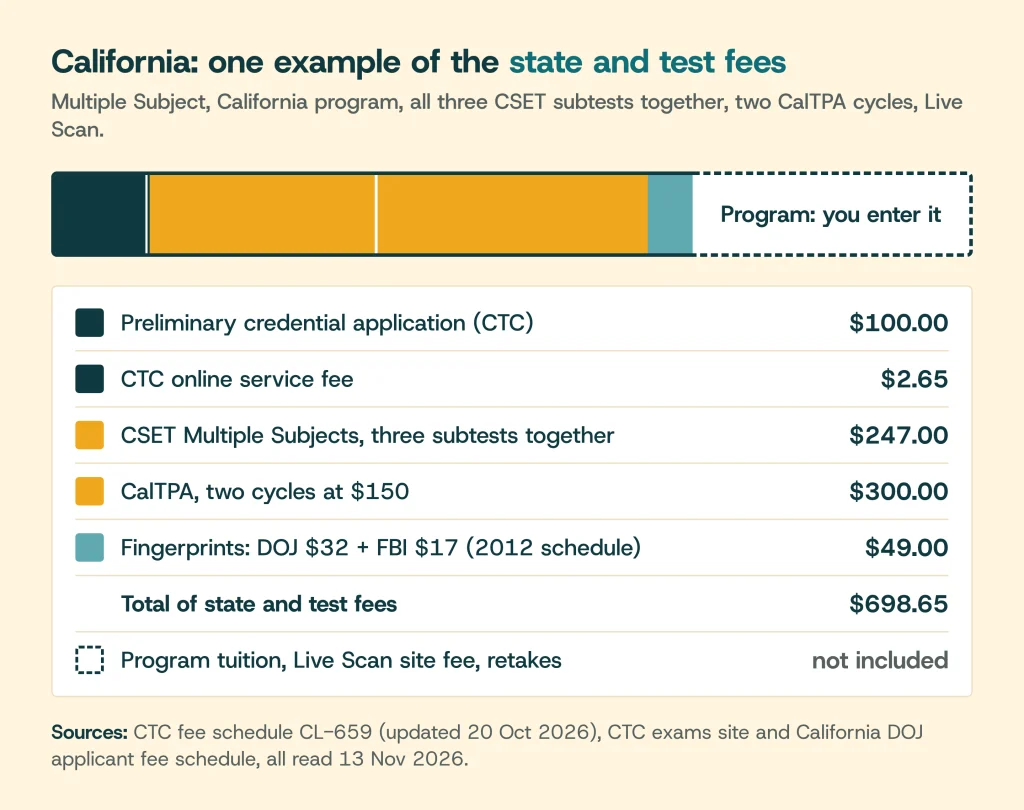
The total leaves out three things: the Live Scan site’s own fee, any retakes, and program tuition, which only the program can quote. A candidate who meets subject matter through coursework or a degree major instead of the CSET would pay $247 less, or $451.65. If a Certificate of Clearance is bought first, it adds $52.65 at that point, and the CTC credits $50 of it toward the credential. To try other cases, use the teacher certification cost calculator. It is an estimate, not a quote.
Moving to California with a license
There is no national teaching license, and no automatic transfer between states. The CTC gives teachers prepared in another state three routes. The Multiple Subject version is in CL-561 (updated 1 October 2026, read 13 November 2026), and the Single Subject version in CL-560 follows the same structure. Both start with a comparable professional-level credential from another state or U.S. territory. That means one issued after a preparation program or an alternative program, including student teaching, completed at a regionally accredited institution. The out-of-state credential doesn’t have to be valid at the time of application, and its subject area must match the California credential sought. If it covers middle school only, a Preliminary can be issued, but California’s subject-matter requirement must be met before the Clear.
- Route 1: under two years of full-time out-of-state teaching. A bachelor’s degree plus the comparable credential leads to a Preliminary credential. To clear it, the holder must meet subject-matter competence if it wasn’t met at issue, complete induction and earn a California English learner authorization.
- Route 2: two or more years. Requires a letter from the out-of-state employer and either two satisfactory performance evaluations or supplemental evaluation letters. This route can lead to a Preliminary or straight to a Clear credential, and it is exempt from induction. To clear, the holder must meet subject-matter competence if it wasn’t met at issue and earn a California English learner authorization; if both are met with the first application, the CTC issues the Clear directly. Full-time means at least 4 hours a day for at least 75% of a school year, in regionally accredited schools outside California. Day-to-day substitute, adult education and career technical teaching don’t count.
- Route 3: National Board certification in a qualifying area, plus a copy of a professional-level credential from another state, leads to a Clear credential. It is exempt from the basic skills requirement and all other requirements except fingerprint clearance.
Applications go through an employer or directly to the CTC through CTC Online. The fee is the same $100 plus $2.65, and the CTC lists no separate evaluation fee (CL-659). The CTC also accepts basic skills exams passed in another state (CL-667).
The teacher compact. California is not a member of the Interstate Teacher Mobility Compact (the compact’s own map and teachercompact.org, read 13 November 2026). The routes above are the ones that apply. To see how a move from or to another state is handled, use the teaching license reciprocity checker. The receiving state decides the equivalent license.
Clearing, renewal and substitutes
From Preliminary to Clear
A Preliminary credential is cleared in one of two ways (CL-561C, CL-560C):
- Option 1: a Commission-approved Teacher Induction Program, a two-year mentoring program done on the job. The CTC tells educators to ask their employer about enrolment (CL-561), and the induction sponsor submits the Clear application.
- Option 2: National Board certification in a qualifying area, earned after the Preliminary was issued.
Each holder’s own renewal requirements are shown in their CTC Online account (“Clear Your Credential” page, read 13 November 2026).
Renewing a Clear credential
The Clear credential is issued for five years (CL-912) and renewed online. The fee is $125 plus the $2.65 service fee, a rate in force since 1 July 2026 (CL-659). The CTC says Clear credentials “are not held for professional growth requirements”, and the pages we read give no hour count for renewal (“Clear Your Credential” page, read 13 November 2026). Other renewal rules, from the CTC renewal page (read 13 November 2026):
- A credential can be renewed up to one year before it expires.
- The CTC sends an email reminder 90 days ahead, but renewing on time remains the holder’s responsibility.
- A credential that has been expired for more than 18 months may need new fingerprints.
See teaching certificate renewal for other states.
Substitute permits
- Emergency 30-Day Substitute Teaching Permit (CL-505p, updated 23 October 2026; Title 5, CCR 80025):
- Requires a bachelor’s degree from a regionally accredited institution, which since 29 June 2024 also meets the basic skills requirement, plus fingerprint clearance and the application fee, $100 under CL-659.
- The holder may substitute in any classroom for no more than 30 days for any one teacher in a school year, or 20 days in a special education classroom.
- Valid for one year and renewable online.
- The employer must keep a Statement of Need on file.
- Emergency Substitute Teaching Permit for Prospective Teachers (CL-505d, updated 23 October 2026; Title 5, CCR 80025.2):
- Requires at least 90 semester units from a regionally accredited four-year college, current enrolment in a regionally accredited four-year California college or university, and the basic skills requirement, which a degree can’t meet here.
- Limits: 30 days per teacher (20 in special education) and 90 days in a school year.
- Renewable once, with 15 more semester units.
Our substitute teaching guide covers other states. Apart from the Emergency 30-Day Substitute Permit, which the CTC renews online, the CTC renewal page says emergency permits and waivers may not be renewed. If you hold one, the CTC’s advice is to talk to your employer before it expires. For how emergency documents work elsewhere, see emergency teaching certificates.
Next steps and official links
- Find your route’s leaflet on the CTC teaching credential requirements page. Each leaflet lists the documents and has a checklist.
- Apply through CTC Online (direct application submission). Program completers are recommended online by their program sponsor. The application ends with the Professional Fitness Questions and payment.
- Fingerprints: the CTC fees and fingerprinting page (form 41-LS) and the DOJ’s Live Scan locations.
- Tests: register for CBEST, CSET and CalTPA on the CTC exams site.
- Programs: the CTC’s approved institutions and programs dashboard.
- Look up a credential: the CTC’s official educator credential lookup, which the CTC calls the official record of certification.
- Fees: CL-659 fee schedule. The basic skills statute is Education Code 44252.
Have ready: official transcripts showing the degree, test score reports or subject-matter verification, proof of the U.S. Constitution course, a Live Scan receipt or fingerprint cards, and, for out-of-state routes, a copy of the other state’s credential plus the employment letter and evaluations. To see California next to the other states, use the teaching route finder or the teacher certification by state table.
Rules and fees checked on 13 November 2026, against the CTC’s own leaflets and pages (CL-402A, CL-505d, CL-505p, CL-560, CL-560C, CL-561, CL-561C, CL-659, CL-667, CL-674M, CL-707B, CL-840, CL-900, CL-912, and the renewal, clearing and fingerprinting pages), Education Code 44252, Program Sponsor Alert 24-10, the CTC exams site, and the DOJ fee schedule. The edTPA fee was read on edTPA’s candidate policies page on 13 November 2026, and the list of approved TPA models on 12 November 2026. CTC fees often change on 1 July.
Sources
- CTC: Teaching credential requirements
- CTC leaflet CL-561C: Multiple Subject, prepared in California
- CTC leaflet CL-560C: Single Subject, prepared in California
- CTC leaflet CL-561: Multiple Subject, prepared out of state
- CTC leaflet CL-560: Single Subject, prepared out of state
- CTC leaflet CL-402A: University Intern credentials
- CTC leaflet CL-707B: District Intern credential
- CTC leaflet CL-840: Early Completion Intern Option
- CTC leaflet CL-912: PK-3 Early Childhood Education Specialist
- CTC leaflet CL-667: Basic Skills Requirement
- CTC leaflet CL-674M: Subject matter by examination (Multiple Subject)
- CTC leaflet CL-659: Fee schedule
- CTC leaflet CL-900: Certificate of Clearance
- CTC leaflet CL-505p: Emergency 30-Day Substitute Teaching Permit
- CTC leaflet CL-505d: Substitute permit for prospective teachers
- CTC: Direct application submission
- CTC: Fees and fingerprinting
- CTC: Renew your document
- CTC: Clear your credential
- CTC: Approved institutions and programs
- CTC: Credential lookup
- CTC Program Sponsor Alert 24-10 (revised 24 Sep 2026)
- California Education Code section 44252
- California Educator Credentialing Assessments (CBEST, CSET, CalTPA)
- edTPA: candidate policies (fees)
- California DOJ applicant fingerprint processing fees
- California DOJ: Live Scan locations
- Interstate Teacher Mobility Compact